26 June 2012

On The Road

Looking at my roster, I am supposed to have about ten to twelve days of rest time a month.

Yet, I feel that I haven't caught my breath yet from running around like a beheaded rooster.

The past few weeks, my mind has been away from the flying world even though I have been up in the air with no abatement of frequency. The days slipped  by, up in the morning, landing in the evenings, one-rig sectors, two-rig sectors, three-rigs, were all slowly merging images of days being ticked off the calendar towards sorting out the other aspects of life, which is always reaching forward. Even refuelling stints are now routine for me.

East Piatu is yet another rig with refuelling facilities, and in fact it has a pretty nice fuel pump, and I say that because it is new, which makes for speedy top-ups. We had landed there on a long legged sector, and transmitted that we would need about 550 litres of fuel to be topped up for the remainder of the journey.

Upon landing and shut-down, the team was ready to clip on the bonding wires to dispense the static electricity lest an arc ignited the paraffin fumes. They spoke to the captain, all business-like, as if this were a Shell station along the highway. Except that no, I didn't see anyone with a filthy old rag, baseball cap and chewing gum.
Water Contamination Check In Progress

Two chaps were standing by with a jar at the nozzle end of the fuel hose to check for water contamination. They were both Indian, and after syringing the fuel up through the contamination check pill, they shook their heads at each other. One then said, Thanni illai? which meant no water?To which the other shook his head in concurrence. Watching them closely, I said, Athu serri, or alright. They looked at each other and then started grinning like a pair of truants who had been found out by the prefect. And I too, love the effect I have on the unsuspecting when I throw in a few words of Tamil.

No, I can't really speak the language, but I can get by in a Chettinad restaurant, albeit to the very limits of my cranial capacity. Owing to the fact that I look nothing like what people expect a Tamil chap to look like, the chaps at the restaurant get rather tickled that a Malay man is ordering the most artery-clogging food in their language.

With the water contamination test done, it took only five minutes to fill up the feeder tanks to the required amount, and mopping-up was already taking place before I could return to deck from a visit to the restroom. My two Indian friends were there and the darker, gruffer one said, "Thanks sir. Next time we meet on shore we will have thanni also." I caught his wink, as thanni also means beer in Tamil.

"Yes," I replied with a smile. "But that will be varrai thanni."

But an Oktoberfest will probably have to wait till October with the way things are rushing along for me.

There was also a sortie to Global Sapphire, which once again was not destined to occur because the barge's roll was at 3.4 degrees. We elected, just like the last time, to land instead on Angsi Delta's fixed platform. It was my turn to get out of the cockpit and supervise the passenger exchange. I strolled forward to Angsi's deck edge to take a look at Global Saphhire tossing about, and today she looked a lot moodier than she did before. The buffer buoys at her keel were also flung upon the waves, slamming into her sides. My eyes traced the deck to where her passengers would have climbed up the staircages to board the helideck at Angsi D, and I could see why these structures were called "widow-makers". The horizontal staircase and vertical staircase were virtually scissoring into each other, and anyone using those stairs would be in danger of severing a limb or crushing his skull. 'Tis not an easy life this, making a living from the sea.

On the domestic front, it looks like all my 5-day stand-downs have been used up on the road. First, it was a rush down to KL to retrieve my upgraded license, combined with a recce of potential colleges in which to enroll Ethan. We had so little sleep, and so much driving to do. GPS is a great driving companion but seriously, there is a 15-metre lag between the actual junction and the GPS voice and graphics prompt, which resulted in missed turns and the word from the GPS that makes me curse and cringe: "Recalculating..." I for one, never knew I could drive on just 2 hours' sleep from KL to Kerteh. Well, I used to ride on my old GSX 400f on four hours of sleep on that same leg when I was younger. But riding is different. Once that engine starts and my hands are on the handlebars, I whizz, whirr and wind up like Optimus Prime in metamorphosis. Driving on the other hand, can catch me wandering off, but I use aids...such as Werther's Original coffee swirls. Those pep me up for about 50km at a go.

After the college hunt, my medical check was due, which meant another drive down to KL during my next 4 day stand-down. We vintage ones have a 6 month validity on our medical check, and mine came around sooner than I could prepare myself for, but then a guy's gotta drive when a guy's gotta drive. With trips to KL in suuch rapid succession, I am now getting very used to the sights and landmarks of the East Coast Expressway. It always seems tedious the first few times, and you wonder how weekend husbands and others do this week after week, sometimes travelling as far away as Malacca and back and perhaps even further. After a while, your mind starts turning the towns you pass like pages in a book, and like a well-read one, you know you are making your way to the conclusion at the final leaf that you flip.

A picture snapped by my Thai colleague
when he caught me devouring a black-bean bun
And yesterday, I finally said goodbye to Joey, my war-horse Toyota SE. For the last time, I drove her, still enthralled at her ability to wind up to speedy passes and overtaking with confidence when traffic began to drag along the single-carriageways from Kemaman to Kuantan. She was still a good drive, stable as a boulder and thrilling in corners. She has served the family well. She was the long drives Brenda took on her own with the toddlers when I was on SAR standby in Kuantan, the getaways from the red-eyed hamster-wheel ride of staff work in MINDEF to a breather in Malacca, the second posting to Labuan and the return to Semenanjung as a civilian. She has been handed over to a pleased salesman in Kuantan.

I will see her no more.

At the end of it all, I sometimes puzzle over which part of all this is where I really reside. We tend to think that we live apart from our work lives, that it's merely the means by which we make bread while what we do away from work is where the truth is. We long for our annual leave, public holidays and extended weekends to be with the people we love, to have quality time with them. As for me, I am beginning to believe that there is another, rather askewed view than such poetic simplicity. I think it is possible that it is work that helps me to gain a return to normalcy. The sight of workmates, my colleagues from Thailand who are husbands in exile, the never-ending checks and reviews and aiming to be a better pilot with each sortie, can serve as the draw away from the whirlwind days on the road as the revolutions slow to a manageable pace. After all, guys, sometimes "leave" is another word for "chores".

Yes, I am going to recover from leave at work.


11 June 2012

Cockpit Conversations

Me: Kerteh Tower, Tango Juliet ready on line up runway 16.

Tower: Tango Juliet right turn clear take off.

Me: Clear take off Tango Juliet.

Me: We are clear for lift off sir.

The Captain: Ok. Monitor my take off.

He gently raises the collective, and we hover at ten feet from the asphalt.

Me: Ok sir, you are pulling 83 percent power, Ts and Ps good, Nr at 103.8, FLI good.

The Captain: Ok, controls normal and rotating.

He eases the cyclic forward and the chopper accelerates to a gentle climb. Passing 500 feet, we carry out the after take-off checks, drawing up the landing gear and setting the altimeters and other navigation aids.


20 miles away I make my first range call, as is the procedure. "Kerteh, Tango Juliet 20 DME."

Tower answers acknowledgement, and requires another call at 40 miles. "WILCO, QNH 1007, next call 40 DME Tango Juliet."

There is never a dull moment on the frequencies, whether Kerteh  Tower or Helibase. Someone is always making a range call to update the ops centre or traffic control, or tell all stations flying that he is descending to the destination rig. Some chat on helibase's frequency to keep their fingers on the pulse of their neighbour's flying life, others yet to determine where each other are at any given moment so they can maintain pilots' separation in the ops area.

Suddenly a plaintive voice rings out.

"Tuan-tuan, kita akan mendarat sebentar lagi di pelantar Angsi Delta. Sila pastikan tali pinggang keledar anda diketatkan sehingga selamat mendarat dan pintu pesawat dibuka oleh kru pelantar helikopter. Kami mengucapkan selamat bertugas dan semoga berjumpa lagi di penerbangan akan datang."

Or:

"Gentlemen, we will be landing at Angsi Delta platform shortly. Please ensure your seatbelts are securely fastened until the aircraft doors are opened for you by the helideck crew. We wish you a pleasant stay offshore and hope to see you again on the next flight home."

I turned to the captain and said, "Excuse me????" He gestures a gleeful shhhhh to me, waiting for all hell to break loose as he seemed to know it would.

Hardly a second after that peculiar script, all voices hurled in.

"Woi, siapa nyanyok tu????????????" came one aircraft captain's voice over the radio.

"Saya punya dah ketat dah!!!!!!!!!!!!!" my captain joined in."MY belt is tight, my belt is tight!!!!!!!!!!!!"

I laughed hysterically in my seat, quaking like a leaf in a thunderstorm. I knew it had to happen one day. Somebody was going to give the passenger brief over the air instead of inside the cockpit.

Man, I am glad I don't enjoy the distinction of being the pioneer on this one.

04 June 2012

Just Soot Me

It was a routine trip out to a mobile barge named Global Sapphire. Prior to departure especially for mobile barges and FSO ships, the specific weather report containing the pitch and roll limits are scrutinised to determine if the barge is within safe limits for a deck landing. Just think about trying to land a helicopter on let's say....the Black Pearl tossing in the wake strirred by an angry Kraken. This is what we refer to as an exaggeration to depict a point. Pitch and roll limits exceeding 3 degrees would make landing the helicopter on deck hazardous. Global Sapphire's weather report stated the roll at 2.4 degrees. It wouldn't take much for that to swell to 3 or more.


The weather outbound was serene, with a healthy tailwind speeding us onward to the barge. Oh, I could use that, especially when it was my second running sortie after having done the 7 am muster to two rigs, as the sooner we got there, the sooner we would be home. Thankfully I was flying with a most placid aircraft captain. I did not serve with him in the air force, therefore there was no residual history on which to pick in order to show me who the better pilot between us was. 40 miles out and the stable atmosphere manifested in carpet cloud at 2800 feet.
These cumulo-stratus are simply called carpet cloud, with no similarity to a luscious shagpile

The ten-minute prior landing call to check on the current weather at Global Sapphire revealed that the barge had a roll of 2.5 to 3 degrees. As it was colocated with Angsi Delta, we decided to carry out the passenger exchange on deck Angsi Delta instead.

As we descended to the lower atmosphere, it began to get gloomy with haze. Angsi was a pale skeleton against the grey background, and all that stood prominently was her raging erect flare emitting much soot above the plume of flame.
Smoke Gets In Everyone's Eyes

We trailed past the rig to set up for a running in on finals to land. All was going well when at just 300 feet above deck, the radio operator called out, " Tango Juliet, Angsi Delta here we have a stop-work alarm now, deck not clear for landing." I acknowledged the call and the captain executed a baulked landing, depressing the "go-around" button and climbing away from the approach. Just half an orbit later, I called in for an estimate of the delay. The radio operator replied that all was in the clear and we could land on deck.
So who's setting fire to the rain again?

As I was supposed to fly the leg home, the captain got down to supervise the passenger drop-off and pick-up while I stayed in the cockpit to give the passengers their welcome-aboard brief and make the all-stations departure call. I looked towards the right and there she was, miss Global Sapphire, tossing and twisting on what looked like a tempestuous sea. Odd, I thought. We approached to land in virtual nil-wind conditions. Why then was Global Sapphire so unstable? Perhaps because she was no different from any rescue boat, except that a helicopter platform was sewn onto her head, just above the bridge at the bow making her top heavy and with the propensity to behave like The Milkmaid from Aesop's fables.
Global Sapphire tossing like a captured croc

I learned this day, what a 3-degree roll looks like. It was enough to make me dizzy, and I don't see myself even imagining a landing on anything like that.

28 May 2012

Clouds

The radiant sun cascading into the sea
Bows and flows of angel hair
And ice cream castles in the air
And feather canyons everywhere
I've looked at clouds that way
Flying beneath a wild raging storm
But now they only block the sun
They rain and snow on everyone
So many things I would have done
But clouds got in my way
Coming out to the other side
I've looked at clouds from both sides now
From up and down and still somehow
Caverns of cumulous

It's cloud's illusions I recall
I really don't know clouds at all

The taste of deoxygenated blood is slowly leaving my mouth as the troubles of the tumultous preceding three weeks slowly dwindle to the calm of a passing storm, and my heart has returned to my chest. I have not felt like reading anything, my 5km jogs at the gym have been laboured and I have even considered giving up cycling as my rear tyre has been running flat or exploding ominously every time I set out for my opportunity-based jaunt down to Kijal and back to vibrant Kampong Chabang.
FSO Bunga Kertas

For three weeks, the time frame required for the authorities to peruse my submissions to upgrade my humble CPL to an Air Transport Pilot's License, I have been agonising over whether it was going well. I was short on some paperwork, and I did receive a call over that singular missing document, to which I pleaded guilty. I suppose the staff at the department did go out of their way, in particular one kind lady who remembered me from my Civil Pilot's License application in 2010, and she hunted down the department's copy to complete my recent submission.
Bekok C with her distinctive flare stack

Therefore, upon getting the news that my readied ATPL was waiting to be taken home, even a stormy ride out to the rigs seemed like a cheerfully lit morning sortie amidst visiting cherubs from heaven. I will not be made an aircraft captain now, especially not when I am still pinned to the opinion that my handling is as capricious as Bambi upon finding the meadow, but holding this little booklet says that the legal hurdle to making command is out of the way, condescending views notwithstanding.
A container ship stirring up a multi-coloured wake

For that I thank my Creator, who keeps His blessings showering upon me. I will keep my word. Or at least as much of it as I can muster.
On deck Bekok Alpha looking out at Bekok Charlie

But He too, must keep His, and speed up the arrival of the new car before this old 1992 Joey runs up livery costs that ruin me.
Dulang Bravo and FSO Putri Dulang

Ok, forgive me for inverting prophet Samuel's response. You win, always.

06 May 2012

Penta Gramme

A Far Green Country
The past 5 days have been multifaceted.

The start of the week showed great weather. From take-off and heading outbound to the new rigs I really believe I could see all the way out to Kelantan. I do not recognise many of the east coast islands save for Pulau Tenggol, as it sits on the 20-mile range mark from Kerteh, and Pulau Kapas abeam of Marang, but each time I look at Pulau Kapas, I think of a friend of mine who encouraged me to become an offshore pilot. Yes, it's the Pirate King of Kapas Island, Captain Sharif Abbas.

The air force's Bersama Lima air defense exercise had hemmed us in a bit over the the past days. They had occupied our operational airspace from 5000 feet and up, which meant that we had to cram into the lower airspace registers till they had done convincing themselves that they were protecting this country from an external threat. Being fighter jocks, it would take 6 days for them to to feel sure that they served a purpose in bonny Malaysia.

The convention is that the operators fly outbound at odd heights, say 3000 or 5000 feet and even heights inbound. This was in compliance with the rules of seperation, and was pretty convenient for our mental air picture, and also when faced with air conditioning failure, we could fly high enough to draw in cool air at altitude!! Missing out the cool air at 5000 feet was well...rhubarb rhubarb!!

Smoke On The Water
On the final day of the exercise, as we were rejoining from Lawit Alpha, an oil rig almost dead on the northerly cardinal heading from Kerteh, we heard air traffic chattering with some Tudung Selar formation or something. Ahhh...fighter jocks in helicopter territory!!

We descended under air traffic instructions, and were advised that our reciprocal traffic was a 3-ship formation of  Sukhoi-30s, with some serpentine callsign, just past Dungun en route to Gong Kedak, their home base. At 1000 feet, I began to keep my eyes peeled for them. Then I heard my captain snap."Visual!!" I looked in the direction he was staring and there they were in maritime grey, at about 500 feet above ground level.

Barges On Tow
"Kerteh, I have the 3 Sukhois visual and on my TCAS."  he called out. There was no response from the fighter formation. There was no see-and-be-seen acknowledgement or sighting and passing radio call. Or they didn't spot us I reckon. It's bad enough being spotted by other military aircraft, but to lose stealth to civilians is just heart rending. But then, both my captain and I carry air force hours under our belts.

Today we had thunderstorms from take off to landing at Kerteh. It was an opportunity to clock instrumented hours.

Haze too, has turned the aquamarine seascape into a sullen featureless colloid, making familiar ships like FSO Angsi and her family of rigs a miserable vista in the choking grey shroud.


A Jack-Up Rig Being Towed Out
There are barges dragging our wealth to unrevealed harbours. Then there are the jack-up rigs being towed out to new oil fields...and jack-up rigs being towed back to port. Fishing boats, tankers, luxury liners and various seafarers scrape their bridal train wakes as they plough this hive of activity, going quietly about their business as we fly forth and back keeping the business of digging for black gold uninterrupted.

It's the end of my five-day cycle. I will start my five-day rest cycle not by resting, but by pursuing an impossible dream.

Let's see how that goes.

02 May 2012

You Don't Know Jack

We're Starting Up A Brand New Day
It was a clear bright morning on the 30th of April, my last day at work for this month. I was on the early morning flight out to Ensco 106, a jack-up rig about an hour and a few minutes out. We were a tad late on departure as the refueling bowser was on our competitor’s dispersal first, filling up her empty aircraft, all four waiting for a busy morning’s launch. Knowing that Ensco 106 was 67 minutes away meant that I didn’t have to knot up and rush through the platform chit and I could contact the rig for its payload after exiting Kerteh’s extended zone boundary at 40 miles waiting twenty minutes after takeoff.
The Mirror Never Lies

My captain looked down at the serene sea, commenting on the nil-wind situation as he could not spot any white caps upon the seascape. I mumbled in agreement, my mind occupied with the hope that the local wind at Enscoe 106 would allow me to execute the approach and further improve my handling of this new-found relationship with mammoiselle EC225. I gazed up at the rearview mirror and watched the blades whirring steadily, enjoying the moment. Then I looked down and spotted the oil slicks, a common sight here.
Oil is lighter than water
We were without TCAS, the traffic collision avoidance system, a set of transponders and radars that would warn us of any aircraft posing a collision threat, and further, if no pilot action was taken within closing collision threat range, would automatically execute altitude changes dependent on the height of the threat aircraft, resuming original altitude once the threat no longer existed. Without TCAS, the old "See And Be Seen" rule would apply.
We Avoid Our Friends

So the captain perused the flight programme and noted that another aircraft would be crossing our flight path in a few minutes. He contacted the crew of the other aircraft and we soon ascertained that they would be crossing us in a few seconds, judging from their distance away from us at 5 miles. They called out visual with us, and there they came chugging, 500 feet above us from the south, crossing our flight path on their inter-rig voyage for the morning. The AB139 is already a petit aircraft. Not as petit as the Bell206, true, but petit enough to not make a formidable silhouette 500 feet above us due air traffic separation. I craned my neck towards the right, my eyes trailing after them as they gradually increased in size, crossing overhead and diminishing towards the north. We don’t always get to see our friends up close and personal in this business where close formation flights are not even on the cards, so this was as good as it was going to get.
A Shower Before Arrival
An hour’s time was up. We called out to all operators that we would be descending to Enscoe 106 and I leaned forward to discern the platform on the left side of the rig. Yes, this would be my approach. There was some rain and a storm cell further left, making the sea beneath it emanate different shades of blue. We got down to 500 feet above the sea, trimmed the airspeed to 80 knots and I stared past my captain’s seat towards the rig to note when it passed my 3 o’clock. Deselecting the heading hold on the upper modes I swung the aircraft to the right to roll out on a finals configuration of 500 feet and 50 knots with the platform’s superstructure on my left. It was all mine now, and the captain could not bail me out if I baulked, because he would not be able to see the superstructure and obstructions from his seat. Happy with what I saw, I disengaged all four axes of stabilization and commenced the approach.
Colours Changing Hue
I drew back on the cyclic to keep the approach speed comfy and to keep the rate of descent progressive. But I knew that soon, closer to the deck, I would have to raise the collective to slow down the speed and sink rate to that of a walking pace. But it would be about that moment that this French horse would screech her hooves and try and throw me off composure. No, I knew what she would do. As soon as I felt her about to dig into the ground, I pushed forward with the cyclic. This was the second phase of the approach that previously would throw me so off centre. No more. I have her eating out of the nose bag now. A bit more and she will eat out of my hand.
The Jagged Jack
Once securely on deck, my good captain, senior to me in the air force, when he was in it, volunteered to get down and monitor the passenger drop-off and pick-up. I sat in to preselect the cruise altitude home, provide the passenger brief and make the all-stations call to announce our lift-off and altitude back to Kerteh. When all was ready, the captain strapped in and allowed me to fly back home, since he flew the outbound leg. En route, I wondered at the Angsi rigs, in particular Angsi Alpha, and how sooty her flare was. In the still morning air, the flare ended in an erect plume of soot, which in combination with the humidity and low temperature this early in the morning converted at its upper end into a miniscule formation of cloud. I had seen such phenomena before during Ops Kemarau, doing Bambi Bucket operations in the raging forest fires of Sabah circa 1999. It was déjà vu on one hand, and curiosity on the other at what kind of gas had they had hit to give off so much soot. If our track back home were further right, I think we could have passed through that sooty plume at 2000 feet. Yes, this is exaggeration to depict a point. It was about 800 to 1000 feet tops. But sooty none the less.
Smoke Rises From Isengard
We eventually landed at Kerteh, and I shot off to flight planning to settle the post-flight paperwork. I checked the flight detail and found that we were on the 1115hrs schedule for Naga3. That too was a jack-up rig. Jack-up rigs are exactly that; rigs towed out to sea, buoyant on the sea at the bottom of their jacks, then at the selected drilling spot, the rig is ‘jacked up’ or relatively, the jacks are geared down till they touch the seabed. The jacking continues till the rig is above the variables of tide and element and drilling for oil can shoot full steam ahead.
Naga3 had her platform on the north-eastern end of the rig, so flying out towards her, we semi-circled in a left-handed arc to point towards the rig. Therefore, on finals, the superstructure was on the left. My approach, my landing.
It’s consistent now, the approaches. While I am not perfectly comfortable with her, she doesn't spook me either. It’s never wise to get too comfortable with an adversary, and complacency thwarts self-improvement. But I know that these are no longer fluke shots. I admit that I took longer than perhaps some fresh-faced youthful pilots who perfect the approach right after having it demonstrated to them by the training captain.
I am slow. But it doesn’t mean I won’t arrive.

26 April 2012

Adieu Joey

On Monday morning as I was driving down to Kuantan, I noticed that I was being tailgated by a Vanette. At the Meraga traffic lights, I glanced up through my rearview mirror to check out the menace on my tail, but he seemed to be avoiding eye contact by fiddling with his cellphone. Loathing being tailgated, as the lights turned green, I floored the pedal, losing all traffic behind me in apparent warpspeed and was soon alone on the road to Kemaman. Hardly two minutes from the smoking takeoff, my cellphone rang with a number I did not recognise. I switched to speaker phone.

"Encik!! You kah yang mahu jual Toyota SEG tu? I tadi follow belakang encik nak buat call tanya pasal kereta encik. Wah, dia punya pickup laju semacam encik!"

I nearly laughed out loud in the car. I had no idea that the way I drove could turn into a living advertisment for the car.
An A4 prinout with 'FOR SALE' and my telephone number hung on my rear screen and for two days there was silence. Every time I landed from offshore flying I would look through my cellphone for missed calls or texts, but naught was there for my excitement or endeavour. After 72 hours, the printout escaped my mind, just like living next to a railway station makes you forget the sound of passing trains. Or so the story goes. That is, until I got the phone call on my way to Kuantan on a test drive mission  of my next car.

I remember when I first signed my name off to her in 1997. I had looked at a number of fashionable 1992 Toyota Corolla SEGs, with one champagne gold luvly sitting just 3 grand out of my reach being sold by a very stubborn corporal pressing his price, who knew I had fallen in love with it. So there I was seated in the air-conditioned bank, haggling for a loan the officers were not generous enough to give in 4 percent per annum 1997.

Then a chap from Toyota Labuan walks in, recognisable from his corporate track-pit shirt, asking loudly if anyone wanted a Toyota SE for 36 grand, and I lunged at him, drooling like a rabid bulldog. All the loan arrangements were suddenly feasible and at the end of the day I took her home. The polyethelyne wraps were still on  the seats and pillars after 5 years, with 11 000 km on the clock. After a 4 year stint in Labuan as a copilot, I paid up the duties at customs and took her back with me when I got posted to old KL Base as an aircraft Captain in 2001.

This has been one amazing machine. She never quit. The kids have grown up in her, taken long road trips safely year after year to Butterworth, Kuantan and just about everywhere I was stationed for more than two weeks on Search and Rescue standby. In 2003 she started smoking through her rings. I shopped around for an immediate rectification job and chanced upon a 20-valve Silvertop half cut. The swap was well done in Sungai Besi, quickly followed by exhaust kits and legalising the whole thing at the Road Transport Department.

Then she served with exhilarating performance and reliability through my second posting back to Labuan as the Executive Officer of No 5 Squadron. The return of LA 619 to her old home town was a small joke amongst the air force officers, but then they are always looking for a laugh and if it can be in a friend's face, all the better.

I got Brenda the Vios in 2010, June. It was about time that I sought something with reliability and all the safety bells and whistles, as she was the one shuttling to and fro with our precious cargo, while I was the soon-to-be retired ex Major with an unyielding mid-life crisis ever ready to prove my mettle on the road. Then when I started work in Kota Kinabalu, I took the old SE to KK. She drew all my personal effects to the apartment at Waikiki, through blinding rain and twisty bends pasts landslides and what have you, holding steady at whatever the road threw at her.

In that old home town of mine, my old classmates began to see smoking take-offs from traffic lights. Harry never said a word, but Veramani, who drives like an instrument rated pilot on the road, feared for my life and his if I ever were to land a seat in a sports car. Nay, I said, this IS a sports car, with an Uncle's raiment.

She followed me down to Kerteh when I sought employment as an offshore pilot. Here she stood, four months later after my second exile away from my family, to greet them as they arrived in Kuala Terengganu airport from Labuan. The kids shrieked in delight when they saw her old familiar fascia, calling out in endearment to her, "Hello LA car!!!"

She has been a good, good carriage, so much like Joey.

However, with a family whose luggage mass grows geometrically alongside their linear progression in body weight, it has dawned on me that I need a stronger drivetrain. I have found one, and it is with reluctance that I part with my war horse.

She will soon belong to another.

I will miss her.

21 April 2012

The Next Time I Buy 5 Gallons Of Petrol

Oh, for a pint of cider, beef and onion pie and a nice Orwellian book to go with this sight!!
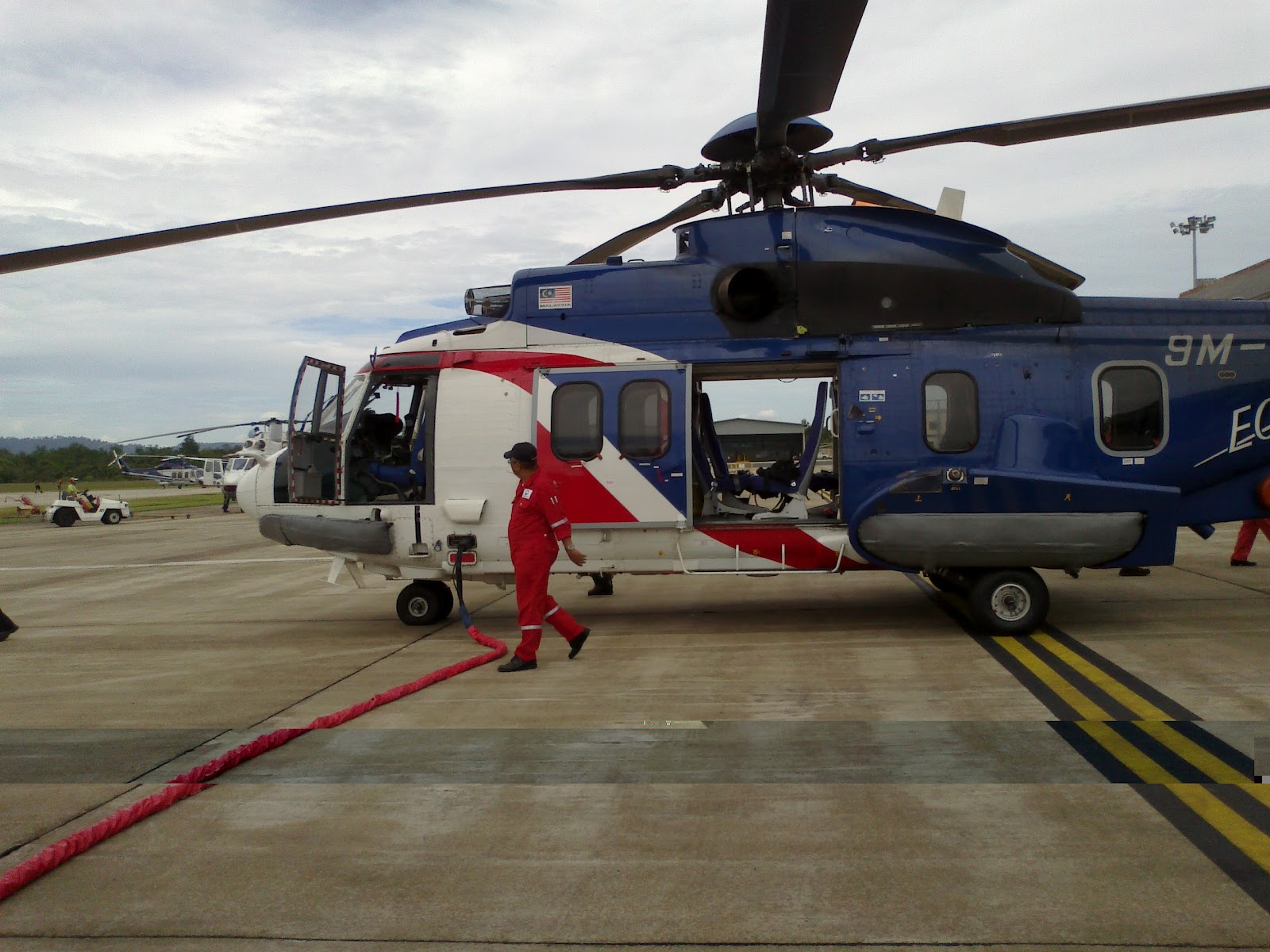
I was mildly excited when I perused the flight detail chit this morning and found that I was due to Belumut Alpha and then onward to East Piatu. Looking at the operational offshore map, I knew that this meant the same thing the last time I was on this very same leg: I was going to refuel offshore. It wasn't a big deal but every little ripple in the monotony was still a welcome ripple. Besides, I could recur what I knew about offshore refuelling procedures. My aircraft captain arrived after I had prepped the paperwork, and asked me if I had refuelled on a rig before to which I answered in the affirmative.

"Good," he said. "Because I haven't."

Helideck hands emptying the baggage before refuelling
Somehow we were assigned to fly only after every other offshore flight had departed. We had just one passenger to East Piatu, with 3 from Belumut and 10 from Piatu respectively returning home to mainland. Somehow it seems like refuelling flights are destined to take off late. This time it happened because the preceding flight encountered an unserviceability and hijacked our aircraft. So we were reassigned to the unserviceable aircraft pending its rectification and being rendered serviceable. Ok, that was not so bad as it allowed my captain and I to gobble lunch. As we both looked under the food warmer lids our enthusiasm was quickly stymied upon finding spiral snails cooked in coconut milk and chilli. These mangrove snails brought back flooding memories of our survival training in the swamps of Pantai Remis where this very same specie boiled in swamp water became the staple diet for our fortnight; my course, his course eight or so years later and every aircrew survival course the RMAF has run. Memories such as these especially vis a vis a meal can be an effective anti-climax.

But we finally mustered the requisite appetite as we knew our flight time would cross the meal schedule and even though we would shut down to refuel, we didn't envisage a casual visit to the galley. As we fed, the helicopter was drawn out at a reluctant tractor-driver's pace from  the hangar and placed upon the dispersal. This ended our meal without much regret at the rush. Start-up and departure was without incident and at long last after an hour's flight at 5000 feet, the twin-platformed rig of Belumut Apha/Ensco 106 floated into view from the horizonless sea.

My Vertical Limit
As the prevailing winds were now from the south-east, it was the captain's approach to land. Shut down was swift, thankfully, as again as I did the last refuelling, I needed the immediate use of the facilities.  I have been on offshore operations for four months now. I must be getting used to the sights on deck. As I went down the same old stairways suspended over the sea, I didn't start quaking at the knees the way Donkey did when crossing the suspension bridge over a boilin' lake of lava. In fact, I took my time to look around, and as I did, I wondered what would go through the minds of these offshore brats living the way they did. Nah, I couldn't feel anything except gratitude that I was getting back to shore. Ok, so that's what they felt when they saw a helicopter coming to pick them up.

Interestingly, this the refuelling process didn't consume as much time as the previous one. Perhaps it was closer between, in about 3 months almost to the date when  I was here for the same purpose and the refuelling before that had lapsed for eight months. The deck crew had their currency, or what these civil world guys called "recency", making them more on the ball this time around.

In fifteen minutes flat, they were done and we were ready to start-up. Kindly, the helideck landing officer asked us if we needed anything courtesy of the Belumut Apha galley. My captain said yes, something light would be nice. Then in a few minutes, after the rotors were running and the passengers were on board, one of the helideck crew handed him a bag of goodies.

My Cup Runneth Over
After lift-off,  a  familiar hollow feeling stirred in our tummies. The captain rummaged in the bag and clicked his tongue in startlement.  He held in his hand a crystalline tumbler. "They gave us cups!!!" he said, his eyes wide with genuine amusement.


Well, I guess there are always free gifts whenever you fill up a full tank at a petrol station.

09 April 2012

Night Cat Whisperer

The weather has changed. Gone the moody monsoonal gloom prevailing over dark of day and black of night. The sun exacts his vengeance on the proceedings of the peoples, making hot the air that they breathe, slower to quench the lungs, too slow to cool in the late hours after he has sailed to the other reaches of the world. The moon hangs over the bejewelled curtains of night, haunting, honeyed and low upon the road that leads home, watching over the pilgrims upon their nocturnal dealings, peering over the hilltops in her dying moments as the sun pursues the limits of her tenure while drawing forth yet another haze-choked day.

There have been days behind me when I doubted my very substance as a breadwinner and an aviator. I presume that this is a common thing amongst pilots. My approaches to the platforms have till a magic moment ago, refused to yield to the descent path I trace in my mind as the flat green shelf creeps into view from whence I fall with very little style onto that shelf, only to end up hovering short of it and then in embarassment and mortification, air taxy like an alien spacecraft to land in the centre of the circle over the 'H' and let the rig workers off. There have been enough portrayals in Hollywood of a tormented bronco buster on a mustang's back being raced to the edge of the corral and then tossed off as the horse yanked its handbrakes at the periphery of the grounds. That's what this doggedly deviant and donkeyed Eurocopter was doing to me. My approaches would begin with academically picturesque precision, till about 200 feet from the deck edge, during the mild flare to arrest slamming into the deck, the Eurocopter would shake off the reins and behave like she had a mind of her own and I would end up wrestling her hard with failing composure to a hasty touchdown. Just like a horse, she seemed to know whom she could bully into a loss of self-worth.
Then one magic moment ago, I could feel her readying to toss me off, when I kept my eye on where I wanted to go and kept her nose down to the spot of my intended hover over the 'H'.

I surmised just in time, that I must always bear in mind that I am not at the controls of a conventional helicopter. This aircraft is ruled by computers. Gone are the hydromechanical lags of the old Sea King, that gentle, ladylike waltzing to slow down upon application of the collective that I was more at home with. The EC225 was virtually instantaneous in reaction to control inputs, and any application of collective on an approach was to be done when needed only, so as not to end up in a premature hover. This, and its abundance of power, gave her the muscle to bully me into defeat. Till that magic moment ago. And since then, my approaches have been consistently good even if I say so myself, because there is no chance that any aircraft captain will.

Perhaps it was just in time that I learned to feel her Gallic nuances, as my 'cat' was upon me. And yes, with it was my 'cat fever'. My head was buried in the manuals, trying hard to trace the logic of French translated into English by a people who hate the language to begin wth, and tying what residual sense all that made to their schematic diagrams and peculiar electronic symbology without a key at the bottom corners of the diagram.

This time, my categorisation, which the civil world calls Base Check, was to be done at night. I was paired with a Thai First Officer whose check was due to expire, and we consulted each other as to how to tackle the Base Check with the newbie examiner. We anticipated that a technical questionairre would be given to us, and so we decided to pore through our Certificate Of Test exam questions to refresh our long neglected ground school knowledge.

This proved to be useful on the night of our Base Check because when the examiner finally turned up, he tossed us a questionairre on the aircraft limitations. Being prepared for this helped set a positive tone for the rest of the night, as it seemed as if we could handle the paper, and so how hard could the flying be?

I am surprised at myself for the way I flew my base check. The examiner will of course differ, but I think I did quite well for a mere 4 months of operational flying on an aircraft we don't really fly hands-on because of all its automation. The civil aviation requirements for a base check do not allow for extensive use of automation. Therefore much of the test is done without upper modes and with hydraulic boosts turned off. If you were flying an older aircraft, with more hands-on flying, this would be pretty much routine. The dilemma of being an EC225 pilot however, is that flying by automation is required by the company and engraved in company policy and operating manuals but base checks are done without these 'upper modes'. Nice isn't it?

But then again, some of my happiest moments in the squadron were during training sorties, working against the aerodynamic loads and feedback by flying with auxiliary servos off. So this night, when my examiner switched off the hydraulic pumps. I listened carefully to the EC225, straining my ears for her whispers. I began overcontrolling a bit and then I stopped all input to correct her. She settled, and much like Bucephalus, required gentle coaxing away from her shadow and not brutal bronco busting to cower her into submission. Right, there she was, and just before she ran away with herself with each control input, I would hold her steady with a whisper of a movement.

I do not get quite enough training hours in the EC225, and that is the case with anyone in a commercial flying unit, but if I did I am certain  could have her eating out of my hand in weeks. Now as I walk out onto the flight line, I no longer see her as a beast or a foe, but as a willing ally, whom I have been dealing with the wrong way. I speak her language now, and though I am not yet her master, this is indeed the beginning of a meaningful relationship. She is a beautiful machine to fly, rumbling through the clouds with nary a complaint. Now that I have set things straight with her, I do not begin the workday with dread. I think I am back.

And it's so good to unclench!!


06 March 2012

My First Legal IR Hour


9MSPE Approaching Overhead VKE 3600

It was an early morning first-wave of flights I had reported in for, a drab grey day with pelting rain and low wintry clouds, except that Kerteh has no winter. Two senior copilots were there in the flight planning room, speaking ponderously with my aircraft captain, in murmurs that ended with a finger pointed sneakily at me and the words, "instrument rated."

I am no more a sunshine pilot!! It's nice having that veil lifted. I can start building up my instrument hours and make this job worth the time it takes from my life. Along with that, so has the mood of the planners with regard to my flight schedule. I seem to be getting more early mornings now, to  muster at the flight planning at 0700. Prior to my being instrument rated, there was apprehension over placing me on the earliest flights as just in case weather was below VMC minima and fell to IMC, I would have been an unsuitable copilot as I was still 'sunshine rated'. This would burden the duty captain with having to recall another instrument rated copilot to take my place. 

Terengganu Crude Oil Terminal Paka
In timely fashion, it was a day of nasty weather the morning after my Instrument Rating Test. It was also the day that the Le Tour De Langkawi would pass through town, so Kerteh was poised for a festive air, but the weather had opted to rain on everybody's parade.

I was on the way back from the rigs in nice sunny weather at 4000 feet when we could hear all aircraft on rejoin to Kerteh requesting for the instrument landing system approach. Staring at the infinitive horizon, a layer of cloud sat on the line where the sea and sky met. That sight, with the content of the radio calls, indicated that the layer of cloud forefronted inclement weather behind it, down to a thousand feet if the ILS was the sudden favourite. I glanced at the captain but he was in his usual sagacious cool vigil, waiting for us to arrive at 20 Distance Measuring Equipment miles from Kerteh when a position report would be necessary for further clearance to enter into the Kerteh control zone. I was tempted to suggest that we track overhead for an instrumented letdown, but he cut me to it and said we would track to overhead at 1000 feet.  Well,  I sighed to myself, he's the captain.
 
Bukit Labohan and TCOT Paka in the background
At the coast, the entire vista was torrential. We could hear the police helicopter's pilot reporting that he was 500 feet above the old coastal road to Paka keeping watch and camera over the Le Tour cyclists, and the helicopters ahead of us attempted talking to him to ascertain his exact location for pilots' separation as they were rejoining from the south of Bukit Labohan. I kept obedient to my captain and tracked for overhead the radio beacon when he prompted me to turn to the northerly heading. As we faced north at 1000 feet, the white carpet of rain beneath our feet turned into a ragged gossamer oval that gave just enough a view of the runway threshold. See the runway, the captain said. Now go and land. And here this offshore pilot readily yielded to air force punch-through-a-hole-in-the-clouds instincts and we made a rapid but smooth descent steeply into the short finals appoach for runway 16 Kerteh.

It was a wet walk back to the flight planning room to submit the navigation log and sector sheet for the trip, for which I had just enough time before a second flight out to the rigs again. The weather had abated on the outbound leg, and 55 miles over the sea, everything turned literally to silver glass, if Tolkien will pardon me. But the way back saw us again in cloud from the same 55 miles inbound.

I was flying with an old squadron mate who had the better sense to quit the air force well before I did and earn his keep in the company. He asked me about my instrument rating and what letdowns I had done for the test. Knowing that I had done a full VOR-ILS seemed to help him make up his mind about the preferred approach and he said, "My base check is this month, so watching you do the approach is good for me." That's right. In the air force or out of the air force, it's all about mutual support.

Looking out the canopy as the aircraft did its thing, taking us steadily and sharply on the glideslope and the localiser centreline through clouds down to 400 feet above mean sea level does a lot to build confidence in the hardware I now use. We taxied in to the terminal building sober as judges and let off the passengers into the arrival hall. Then the captain recorded the flying hours on the flight chit, summarising it with IF 1.0.

Yes, small thing for offshore aviation, but a big thing for a newbie offshore pilot, and I am sure Neil Armstrong will see the point of what I am saying. This was my first ever legally recognised hour of instrument flight. At that moment it no longer mattered that the day before saw me doing all that I hadn't practised in 5 sorties of instrument training, for my test. It no longer stood as relevant that the test profile had departed radically from the rehearsed sorties, making my heart quiver in my throat throughout the test. It didn't matter that I was deemed the most marginal pass in the history of aviation.

All that mattered was, that I was here.

Today was the second day that I was on for two-shuttle flights. Just like yesterday, I began at 0700, landed at ten, rushed through the navigation logs and sector sheets submission and was up again at 1100. Thankfully, my senior captain, the cool one who opted for an air force style approach the day before, was sympathetic and had prepped all the paperwork before I had landed from the preceding flight.

A Busy Morning
This day was a beautiful day for flying. To begin with, it was a full-on busy day with three flights morning, three flights pre-noon and three flights noontime.  The plankton was out in waves and waves, sifting and shifting on the tide, drawing the fishing boats out to bountiful harvests hundreds of miles out from shore. Many of them were from our northern neighbour, coursing between the rigs, eyed territorially by the rigs' supply ships crew. In primary school, I learned that plankton favoured our continental shelf for breeding, causing fish to likewise congregate in our waters. I just had no idea that our waters were so very rich in plankton till I saw it in the course of this job.

Plankton

I have learned that in this job, vigilance is paramount. It's not just about flying off to the rigs, dropping people off and coming back. There is the constant checking and rechecking of the passenger headcount, the ear defenders and life saving jackets return, and the legality of additional freight returned from the platforms. It is not unheard of that passengers have been picked up that were meant for another aircraft. And this day, I learned that when the helicopter deck crew do not read their manifests properly, they can send baggage back to Kerteh that is meant for a passenger that will stay on the rig for a fortnight or more. While that is genuinely out of the hands of the aircrew, we must remember that errors can sneak in through many entry points, and as aircrew, the exercise of captaincy whether one is an aircraft captain or not, is required throughout the offshore operation.

Maybe that's why, whether we are aircraft captains or not, everybody calls us "Cap".