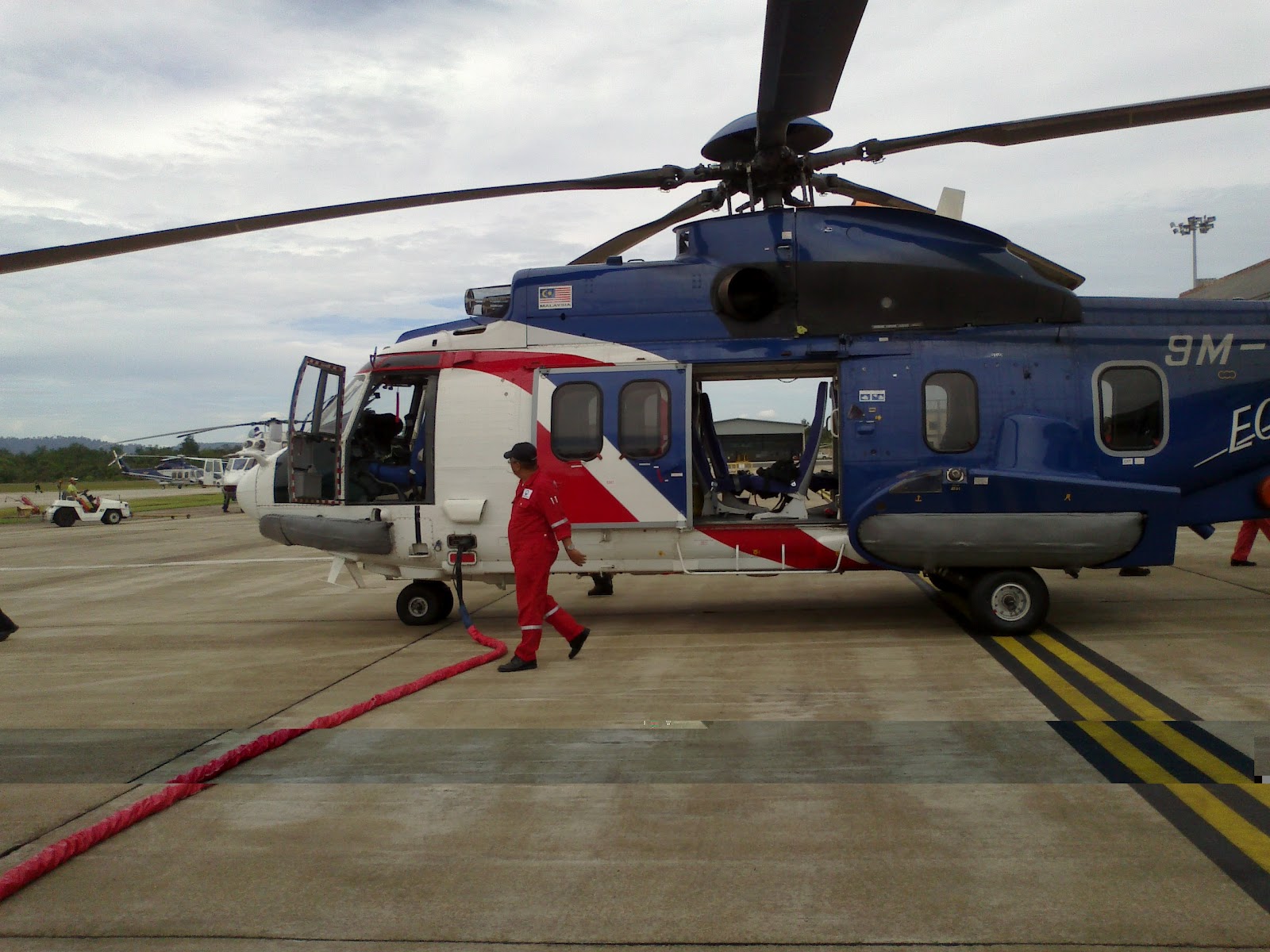
21 April 2012

The Next Time I Buy 5 Gallons Of Petrol

Oh, for a pint of cider, beef and onion pie and a nice Orwellian book to go with this sight!!
I was mildly excited when I perused the flight detail chit this morning and found that I was due to Belumut Alpha and then onward to East Piatu. Looking at the operational offshore map, I knew that this meant the same thing the last time I was on this very same leg: I was going to refuel offshore. It wasn't a big deal but every little ripple in the monotony was still a welcome ripple. Besides, I could recur what I knew about offshore refuelling procedures. My aircraft captain arrived after I had prepped the paperwork, and asked me if I had refuelled on a rig before to which I answered in the affirmative.

"Good," he said. "Because I haven't."

Helideck hands emptying the baggage before refuelling
Somehow we were assigned to fly only after every other offshore flight had departed. We had just one passenger to East Piatu, with 3 from Belumut and 10 from Piatu respectively returning home to mainland. Somehow it seems like refuelling flights are destined to take off late. This time it happened because the preceding flight encountered an unserviceability and hijacked our aircraft. So we were reassigned to the unserviceable aircraft pending its rectification and being rendered serviceable. Ok, that was not so bad as it allowed my captain and I to gobble lunch. As we both looked under the food warmer lids our enthusiasm was quickly stymied upon finding spiral snails cooked in coconut milk and chilli. These mangrove snails brought back flooding memories of our survival training in the swamps of Pantai Remis where this very same specie boiled in swamp water became the staple diet for our fortnight; my course, his course eight or so years later and every aircrew survival course the RMAF has run. Memories such as these especially vis a vis a meal can be an effective anti-climax.

But we finally mustered the requisite appetite as we knew our flight time would cross the meal schedule and even though we would shut down to refuel, we didn't envisage a casual visit to the galley. As we fed, the helicopter was drawn out at a reluctant tractor-driver's pace from  the hangar and placed upon the dispersal. This ended our meal without much regret at the rush. Start-up and departure was without incident and at long last after an hour's flight at 5000 feet, the twin-platformed rig of Belumut Apha/Ensco 106 floated into view from the horizonless sea.

My Vertical Limit
As the prevailing winds were now from the south-east, it was the captain's approach to land. Shut down was swift, thankfully, as again as I did the last refuelling, I needed the immediate use of the facilities.  I have been on offshore operations for four months now. I must be getting used to the sights on deck. As I went down the same old stairways suspended over the sea, I didn't start quaking at the knees the way Donkey did when crossing the suspension bridge over a boilin' lake of lava. In fact, I took my time to look around, and as I did, I wondered what would go through the minds of these offshore brats living the way they did. Nah, I couldn't feel anything except gratitude that I was getting back to shore. Ok, so that's what they felt when they saw a helicopter coming to pick them up.

Interestingly, this the refuelling process didn't consume as much time as the previous one. Perhaps it was closer between, in about 3 months almost to the date when  I was here for the same purpose and the refuelling before that had lapsed for eight months. The deck crew had their currency, or what these civil world guys called "recency", making them more on the ball this time around.

In fifteen minutes flat, they were done and we were ready to start-up. Kindly, the helideck landing officer asked us if we needed anything courtesy of the Belumut Apha galley. My captain said yes, something light would be nice. Then in a few minutes, after the rotors were running and the passengers were on board, one of the helideck crew handed him a bag of goodies.

My Cup Runneth Over
After lift-off,  a  familiar hollow feeling stirred in our tummies. The captain rummaged in the bag and clicked his tongue in startlement.  He held in his hand a crystalline tumbler. "They gave us cups!!!" he said, his eyes wide with genuine amusement.


Well, I guess there are always free gifts whenever you fill up a full tank at a petrol station.

09 April 2012

Night Cat Whisperer

The weather has changed. Gone the moody monsoonal gloom prevailing over dark of day and black of night. The sun exacts his vengeance on the proceedings of the peoples, making hot the air that they breathe, slower to quench the lungs, too slow to cool in the late hours after he has sailed to the other reaches of the world. The moon hangs over the bejewelled curtains of night, haunting, honeyed and low upon the road that leads home, watching over the pilgrims upon their nocturnal dealings, peering over the hilltops in her dying moments as the sun pursues the limits of her tenure while drawing forth yet another haze-choked day.

There have been days behind me when I doubted my very substance as a breadwinner and an aviator. I presume that this is a common thing amongst pilots. My approaches to the platforms have till a magic moment ago, refused to yield to the descent path I trace in my mind as the flat green shelf creeps into view from whence I fall with very little style onto that shelf, only to end up hovering short of it and then in embarassment and mortification, air taxy like an alien spacecraft to land in the centre of the circle over the 'H' and let the rig workers off. There have been enough portrayals in Hollywood of a tormented bronco buster on a mustang's back being raced to the edge of the corral and then tossed off as the horse yanked its handbrakes at the periphery of the grounds. That's what this doggedly deviant and donkeyed Eurocopter was doing to me. My approaches would begin with academically picturesque precision, till about 200 feet from the deck edge, during the mild flare to arrest slamming into the deck, the Eurocopter would shake off the reins and behave like she had a mind of her own and I would end up wrestling her hard with failing composure to a hasty touchdown. Just like a horse, she seemed to know whom she could bully into a loss of self-worth.
Then one magic moment ago, I could feel her readying to toss me off, when I kept my eye on where I wanted to go and kept her nose down to the spot of my intended hover over the 'H'.

I surmised just in time, that I must always bear in mind that I am not at the controls of a conventional helicopter. This aircraft is ruled by computers. Gone are the hydromechanical lags of the old Sea King, that gentle, ladylike waltzing to slow down upon application of the collective that I was more at home with. The EC225 was virtually instantaneous in reaction to control inputs, and any application of collective on an approach was to be done when needed only, so as not to end up in a premature hover. This, and its abundance of power, gave her the muscle to bully me into defeat. Till that magic moment ago. And since then, my approaches have been consistently good even if I say so myself, because there is no chance that any aircraft captain will.

Perhaps it was just in time that I learned to feel her Gallic nuances, as my 'cat' was upon me. And yes, with it was my 'cat fever'. My head was buried in the manuals, trying hard to trace the logic of French translated into English by a people who hate the language to begin wth, and tying what residual sense all that made to their schematic diagrams and peculiar electronic symbology without a key at the bottom corners of the diagram.

This time, my categorisation, which the civil world calls Base Check, was to be done at night. I was paired with a Thai First Officer whose check was due to expire, and we consulted each other as to how to tackle the Base Check with the newbie examiner. We anticipated that a technical questionairre would be given to us, and so we decided to pore through our Certificate Of Test exam questions to refresh our long neglected ground school knowledge.

This proved to be useful on the night of our Base Check because when the examiner finally turned up, he tossed us a questionairre on the aircraft limitations. Being prepared for this helped set a positive tone for the rest of the night, as it seemed as if we could handle the paper, and so how hard could the flying be?

I am surprised at myself for the way I flew my base check. The examiner will of course differ, but I think I did quite well for a mere 4 months of operational flying on an aircraft we don't really fly hands-on because of all its automation. The civil aviation requirements for a base check do not allow for extensive use of automation. Therefore much of the test is done without upper modes and with hydraulic boosts turned off. If you were flying an older aircraft, with more hands-on flying, this would be pretty much routine. The dilemma of being an EC225 pilot however, is that flying by automation is required by the company and engraved in company policy and operating manuals but base checks are done without these 'upper modes'. Nice isn't it?

But then again, some of my happiest moments in the squadron were during training sorties, working against the aerodynamic loads and feedback by flying with auxiliary servos off. So this night, when my examiner switched off the hydraulic pumps. I listened carefully to the EC225, straining my ears for her whispers. I began overcontrolling a bit and then I stopped all input to correct her. She settled, and much like Bucephalus, required gentle coaxing away from her shadow and not brutal bronco busting to cower her into submission. Right, there she was, and just before she ran away with herself with each control input, I would hold her steady with a whisper of a movement.

I do not get quite enough training hours in the EC225, and that is the case with anyone in a commercial flying unit, but if I did I am certain  could have her eating out of my hand in weeks. Now as I walk out onto the flight line, I no longer see her as a beast or a foe, but as a willing ally, whom I have been dealing with the wrong way. I speak her language now, and though I am not yet her master, this is indeed the beginning of a meaningful relationship. She is a beautiful machine to fly, rumbling through the clouds with nary a complaint. Now that I have set things straight with her, I do not begin the workday with dread. I think I am back.

And it's so good to unclench!!


06 March 2012

My First Legal IR Hour


9MSPE Approaching Overhead VKE 3600

It was an early morning first-wave of flights I had reported in for, a drab grey day with pelting rain and low wintry clouds, except that Kerteh has no winter. Two senior copilots were there in the flight planning room, speaking ponderously with my aircraft captain, in murmurs that ended with a finger pointed sneakily at me and the words, "instrument rated."

I am no more a sunshine pilot!! It's nice having that veil lifted. I can start building up my instrument hours and make this job worth the time it takes from my life. Along with that, so has the mood of the planners with regard to my flight schedule. I seem to be getting more early mornings now, to  muster at the flight planning at 0700. Prior to my being instrument rated, there was apprehension over placing me on the earliest flights as just in case weather was below VMC minima and fell to IMC, I would have been an unsuitable copilot as I was still 'sunshine rated'. This would burden the duty captain with having to recall another instrument rated copilot to take my place. 

Terengganu Crude Oil Terminal Paka
In timely fashion, it was a day of nasty weather the morning after my Instrument Rating Test. It was also the day that the Le Tour De Langkawi would pass through town, so Kerteh was poised for a festive air, but the weather had opted to rain on everybody's parade.

I was on the way back from the rigs in nice sunny weather at 4000 feet when we could hear all aircraft on rejoin to Kerteh requesting for the instrument landing system approach. Staring at the infinitive horizon, a layer of cloud sat on the line where the sea and sky met. That sight, with the content of the radio calls, indicated that the layer of cloud forefronted inclement weather behind it, down to a thousand feet if the ILS was the sudden favourite. I glanced at the captain but he was in his usual sagacious cool vigil, waiting for us to arrive at 20 Distance Measuring Equipment miles from Kerteh when a position report would be necessary for further clearance to enter into the Kerteh control zone. I was tempted to suggest that we track overhead for an instrumented letdown, but he cut me to it and said we would track to overhead at 1000 feet.  Well,  I sighed to myself, he's the captain.
 
Bukit Labohan and TCOT Paka in the background
At the coast, the entire vista was torrential. We could hear the police helicopter's pilot reporting that he was 500 feet above the old coastal road to Paka keeping watch and camera over the Le Tour cyclists, and the helicopters ahead of us attempted talking to him to ascertain his exact location for pilots' separation as they were rejoining from the south of Bukit Labohan. I kept obedient to my captain and tracked for overhead the radio beacon when he prompted me to turn to the northerly heading. As we faced north at 1000 feet, the white carpet of rain beneath our feet turned into a ragged gossamer oval that gave just enough a view of the runway threshold. See the runway, the captain said. Now go and land. And here this offshore pilot readily yielded to air force punch-through-a-hole-in-the-clouds instincts and we made a rapid but smooth descent steeply into the short finals appoach for runway 16 Kerteh.

It was a wet walk back to the flight planning room to submit the navigation log and sector sheet for the trip, for which I had just enough time before a second flight out to the rigs again. The weather had abated on the outbound leg, and 55 miles over the sea, everything turned literally to silver glass, if Tolkien will pardon me. But the way back saw us again in cloud from the same 55 miles inbound.

I was flying with an old squadron mate who had the better sense to quit the air force well before I did and earn his keep in the company. He asked me about my instrument rating and what letdowns I had done for the test. Knowing that I had done a full VOR-ILS seemed to help him make up his mind about the preferred approach and he said, "My base check is this month, so watching you do the approach is good for me." That's right. In the air force or out of the air force, it's all about mutual support.

Looking out the canopy as the aircraft did its thing, taking us steadily and sharply on the glideslope and the localiser centreline through clouds down to 400 feet above mean sea level does a lot to build confidence in the hardware I now use. We taxied in to the terminal building sober as judges and let off the passengers into the arrival hall. Then the captain recorded the flying hours on the flight chit, summarising it with IF 1.0.

Yes, small thing for offshore aviation, but a big thing for a newbie offshore pilot, and I am sure Neil Armstrong will see the point of what I am saying. This was my first ever legally recognised hour of instrument flight. At that moment it no longer mattered that the day before saw me doing all that I hadn't practised in 5 sorties of instrument training, for my test. It no longer stood as relevant that the test profile had departed radically from the rehearsed sorties, making my heart quiver in my throat throughout the test. It didn't matter that I was deemed the most marginal pass in the history of aviation.

All that mattered was, that I was here.

Today was the second day that I was on for two-shuttle flights. Just like yesterday, I began at 0700, landed at ten, rushed through the navigation logs and sector sheets submission and was up again at 1100. Thankfully, my senior captain, the cool one who opted for an air force style approach the day before, was sympathetic and had prepped all the paperwork before I had landed from the preceding flight.

A Busy Morning
This day was a beautiful day for flying. To begin with, it was a full-on busy day with three flights morning, three flights pre-noon and three flights noontime.  The plankton was out in waves and waves, sifting and shifting on the tide, drawing the fishing boats out to bountiful harvests hundreds of miles out from shore. Many of them were from our northern neighbour, coursing between the rigs, eyed territorially by the rigs' supply ships crew. In primary school, I learned that plankton favoured our continental shelf for breeding, causing fish to likewise congregate in our waters. I just had no idea that our waters were so very rich in plankton till I saw it in the course of this job.

Plankton

I have learned that in this job, vigilance is paramount. It's not just about flying off to the rigs, dropping people off and coming back. There is the constant checking and rechecking of the passenger headcount, the ear defenders and life saving jackets return, and the legality of additional freight returned from the platforms. It is not unheard of that passengers have been picked up that were meant for another aircraft. And this day, I learned that when the helicopter deck crew do not read their manifests properly, they can send baggage back to Kerteh that is meant for a passenger that will stay on the rig for a fortnight or more. While that is genuinely out of the hands of the aircrew, we must remember that errors can sneak in through many entry points, and as aircrew, the exercise of captaincy whether one is an aircraft captain or not, is required throughout the offshore operation.

Maybe that's why, whether we are aircraft captains or not, everybody calls us "Cap". 

27 February 2012

It's All In The Approach

Yes, this is what the cockpit view is like when I am about to reach a rig or platform a hundred plus miles away from Kerteh. No, it's not me in the picture and I doubt I will ever be in such a position as to snap one like this. It's a gambar sekadar perhiasan of the Puma cockpit lifted from Eurocopter's albums just so you have an idea that one minute we are looking at a platform that for all appearances seems smaller than wang sekupang, and just as you pass below 200 feet above mean sea level (yes, the sea definitely looks mean), there is a rapid change of perspective and the deck and the superstructure suddenly conspire to skewer your cockpit.

Over the past number of weeks, I have been frustrated with my progress. My instrument phase is on ice, so I am still a sunshine pilot no matter what instrument approaches I have been doing when coming home from the rigs.

The offshore flying world is interesting. It's rather like airline flying, save that a helicopter is involved as so far no fixed-wing aircraft has proven an ability to land on a 70-foot diameter platform. As with all other aircraft, the critical stages are take-off and landing. In the helicopter world, we call them departures and approaches. And similar to our better-known brethren in the airlines, any pilot will tell you that approaches are a tinge more complicated than departures.

I have been flogging myself over my approaches. Yes, I know the textbook description of aiming at the forward edge of the platform and then I will be in the dead centre as I get closer towards it. As I began flying offshore in the monsoon, I didn't give any of this a second thought. I had more problems keeping my heading steady the closer I got to the deck because I was born with two left feet. The strong monsoon winds assisted my approaches, correcting for my descent angle without me having to be as precise as those who have ten thousand hours flying offshore. Now, as the skies are sunnier, the winds at the rigs have fallen to single-digit figures. My seniors openly admit that an approach in strong winds is always easier than one in calm winds. One nil-wind day, I began with a correctly steep approach but as I decelerated at the half-way through point, I recognised that I was overshooting the deck. I had to execute a go-around and ever since then, my approaches have left me feeling....inadequate.Yeah, I am gonna nail the approach next time, I would say every time I landed, with the aircraft captain saying, "Hmmmm. You're a bit short.", and I knew he wasn't referring to my hobbit stature. Then the flight home to Kerteh would be in dull silence as I went over and over the approach in my mind, wishing I were a better pilot. Damn!!!

What is it that misery seeks again?

Company.

The surreptitiously gained knowledge that others are not faring any better than you is the reassuring and assuaging balm that you, mortified as you may be at your approaches, are not the only one in your shoes and thereby, not as bad as you may have presumed yourself to be. I had speculated that maybe it was because I haven't acclimatised to this aircraft's peculiar behaviour yet. I had correctly guessed that the ex Puma pilots would be so much more at home in the EC225 because they were flying a predecessor before the offshore clients insisted on the EC225 in the new contract.

It's always a backdoor boost to your self esteem when you find out a whole lot of other ex-Sikorsky/Bell helicopter suck at steep Puma-type approaches too. I have since learned that I am just one amongst many non-Puma-experienced pilots who keep flying the EC as if it was a Sikorsky or Bell, ending up making shallow approaches. Even those who kept up appearances of hotshot swagger actually sucked.

So for now, I will unclench them asscheeks and just enjoy the ride.

12 February 2012

Some Days You Don't Want To

The Hill showing potential IMC
There are days when you don't want to go out cycling. You know you love it; you know that just three consecutive days more of 36km rides will ease up 2 milimetres on the belt. But some days, you just don't want to. When the clouds have frosted the sunlight, and the coast sweeps in a nippy breeze, all of creation says it's time for hot coffee and lazing on the patio bench.
Front Row Seats To The James Taylor Show
After you have perused the skyscape and concluded that you can risk the weather at the behest of that Freddy Mercury's I Want To Ride It When I Like!! looping incessantly in your left ear, you trudge back into the hall to seek out your bicycle only to be subdued by James Taylor's Her Town Too coming warmly over the Rogers telling you to give it up for a lengthy listening session. Yea, some days you don't want to...but you know that you must.

Which brings me to this dreadful turn in the second month every annum. Saint Valentine's Day and its attendant Anti-Valentines Day. Sigh....only in Malaysia.....

If the old martyr knew the asinine clamourings in this country with trite religious, political and non-governmental entities plus some individuals too, exhorting Moslems in particular and Malaysians in general to not celebrate St Valentine's Day, surely he would spin in his grave. I am more riled than the saint...for these exhortations were posted on my facebook for bloody 'ell's sake. Yeah, fine that you warn your flock to stay apart from the rest of us goats, but must you justify it by saying Saint valentine's Day is about immorality? In your loss of control over your own, why sully someone else's day of rememberance and reverance? Keep up this line of logic and we really have more reason and occasion not to meet than to meet and be Malaysian.

First of all, this is Saint Valentine's Day. Amidst the obscurity, it is still Catholic in origin, with its universal values being adopted by all, regardless of creed. On that token, allow me to appeal that you render unto Caesar what is Caesar's and unto God, what is God's. Live, and let live.

In essence, Saint Valentine was a priest who performed the rites of marriage and administered the sacrament of matrimony in secret for those who sought to marry against the decree of a tyrannical emperor, to his own peril. Reflecting on society's failed marriages, divorce rates and the overall breakdown of the nuclear family, in commemorating his selflessness to those who were in love, we may be well served when reminded to go the distance for those whom we say we love even and especially when it hurts us.

The proponents of the Anti-Valentines Day message have not understood the spirit of Saint Valentine's Day any better than they fathomed Seksualiti Merdeka and I have scant trust that this vitriol has its source in semantics. If such were the viral strain of thought that enflames the nation, surely celebrating Halloween and prom night too should be likewise castigated, but nothing has been said about those, right? Phew!! Speak of choking out the gnat but swallowing the camel!!

This divisivity can only be borne in the comfort of never having to trust another human being regardless of race or religion. When your face is in the bush and your arse is covered by your mates who are both your race and not, and the enemy who will shoot you dead is also from your race and not, the epidermial imperative is completely lost.

When men, of your creed and not, trust you to pluck them out of God-forsaken spots in the jungle in your vessel, chased ever lower into the earth by weather that would swallow you up in a flash, you learn that all life, all men and women are sacred. When you take risks to evacuate a woman in the throes of labour from her indigenous village far from any trail and medical assistance, or the wheelchair bound man who has to be carried across the river before he can be placed in your stretcher, the question as to which God he or she believes in doesn't even occur. You are then doing his God's work, answering his prayers to The One and The Same.

You cannot choose how you will die, nor with whom, but you can choose the manner in which you live, and the manifestation of the faith you profess. The car you drive can be crumpled into a sheet on the grille of an oncoming bus, and there you go, believer and non-believer alike in a tangled mass of roadkill. When it is all done, how do you justify to whom amongst the dead shall salvation and eternal life be given? Whom will be left to eternal damnation, whom to the bosom of Abraham? Seriously????
That's Me In The Corner!! That's Me In The Spot-Light!! Losing My Religion!!!!
Therefore in consolation and lengthy conclusion, behold my friend, Mr Effa Rojie who was spotted in the tupperware within which my wife and daughter are trying to germinate some greens for our meal-time consumption. He was no casual visitor. He keeps his bum warmed in the sod, and he has been there for days. I have faith that he has a much better mental disposition than the twits (have I spelled that wrongly??) foaming at the mouth over Saint Valentine's Day. The obvious reason is that this amphibian friend of mine can be seen. He isn't beneath a tempurung, which is infinitely more than I can say for those buggers.

Really, some days I don't want to say anything against the noise of idiocy. But I know that I must, even if it is only and quietly to myself. It worked for Galileo when he had to recant.

And with regard to the politicians, all I can say is Bah!!!!! Humbug!!!!!

28 January 2012

Gassed

On deck, and the view of the crew's feet starboard of the chopper
I wonder how many aviators come here. I know I get visits, albeit unevidenced by entries in the comments page, but I wonder how many copilots will identify with me when I say I loathe young aircraft captains who bitch scream at me in the cockpit.

Somehow the older ones seem calmer, knowing that you will auto-correct minor excesses such as angle of bank or airspeed. But these younger ones seem to have such a chip on their shoulders made of the extra two bars on their epaulettes.

What a demise of decorum on the part of captaincy it is, no matter what justification is used to prop up such outbursts.What a load of hot air, really. I may be greyed to my untrimmed chest, but I do have attitude still. And that is, that I don't give a crap about juvenile aircraft captains who bitch scream at me in the cockpit. I know how to present my most infuriating, obstinate and asinine side when confronted by what I consider inordinate authority. Just ask my wife.

Now that the priorities of the day have been dealt with, let me speak of what is a rarity.

Refueling of the EC225 on a rig.

Fill 'er up mate!!!
The task for the day was to fly offshore workers to two rigs whose total sequential distance required more fuel than a full tank's range could cover. We started off from the airport with near full fuel, and landed with about two thousand pounds remaining. The remainder of the distance to the following rig and the ride home would need in excess of three thousand pounds including bad weather reserves. Since the first rig we were going to land at had the refueling facility for a helicopter, en route, during the call to the rigs for the returning passenger statement, early warning was provided to the helicopter deck crew so that they could make the necessary preparations such as dragging out the correct number of fuel drums and allowing them to stand long enough to allow any sedimentation to settle before our ETA.

I am a newbie offshore pilot. So the novelty was a tad peturbing. Yeah, I had read the offshore refueling procedures in the operating manual and they seemed pretty much the way it was done in the air force. Yet this was an offshore thing and so presumption was not a good ally. I still would have to learn how it was done.

After landing and shutdown, the passengers were told to get below deck due to the refueling op. The fireman came forward to make the bonding contact so as to dispense static electricity which could arc and ignite the fuel fumes, soon followed by the fuel hose and the water contamination test. I had always wondered why the water contamination capsules were shaped like doughnuts, and now as I watched them, I understood. The centre void was designed to fit onto a syringe, and drawing back the plunger would force the paraffin fuel through the ring of the capsule. Any water in the fuel would turn the capsule blue. The chap perfoming the test perfunctorily showed me the capsule, still sitting on the forward face of the syringe, a pale polar mint yellow. Clean. So on with the refueling.


Shrekkk!!!!!!! I'm looking down!!!! AAaaaarrrgggghhhh!!!!!!!!!
  The wait was long. I was really feeling the need to fertlise the flora. I mean crop duster style. As I tread toward the platform edge where the staircase was, I baulked in aghast as I recognised that the staircase comprised perforated steel plates looking straight down to....the sea!!! A hundred feet down!!! So it was a vision of vertigo and horror for me. But I swallowed hard and held  tight to the handrails as I descended, knowing that I just had to use the facilities and comforts of the restroom.

Once the corridors placed the sea safely at my back, I felt better. And hunting down a restroom showed me that these offshore chaps...they are well housed. Each room, or to use the nautical term, cabin, had its own headroom. There was no common headroom, or so I was led to believe. And the headroom was rather, well, Nordic somehow. Or in the least, the one I used reminded me of the one in Stavanger's simulator centre.

Relief for the heavy laden
Back on deck, the refueling was progressing at a pace to suggest that the guys had to distill petroleum first to extract the paraffin. As I strolled on deck, I yakked with one of the offshore workers who was thrilled to impart his mundane everyday facts to a newbie like me who found them fascinating. Of course I had no idea that drilling went down two thousand feet. Only for him to surge me on by saying other rigs drilled to eight thousand feet!!!! Okay. I rarely even fly at that measure above sea level. And, said he, no refueling had been done on this rig in nine months. Hmmm.

After fifty minutes on deck, the process finally ended and the engines were wound up again for the next rig. It was getting late in the day. The extra early morning start was beginning to take its toll on me. It was meant to be a 0745H take off, but the aircraft went snagged, and another was reassigned at 1115H to us to accomplish  the job after the first wave of birds had returned from their flights.

Thank goodness it was my last day before four days of rest. It would allow that bitch scream I heard on base turn to finals to fade slowly away.

23 January 2012

Sun Come Out


It's beginning to look like the monsoon is passing on its way. My training captain told me that a good sign that the monsoon has abated is that the plankton comes out to play. I was for a pause, flabbergasted.

"Plankton?"

"Yes," said he in all earnest, raising his eyebrows at me emphatically. "Look down and you can see for yourself."

And there it was, in flamboyant wisps, like sawdust chromatographed on the mood drifts of the waves. Plankton. I had no idea that I could see plankton with the naked eye.

I beg your pardon that the above picture had to be sourced from Google images courtesy of NASA Earth Observatory which allowed the large scale pic download, as I doubt my spartan 3.2 megapixel Nokia would do anything more than render the difference between blue and white, light and shade.

Yet, thanks to the internet affirmation, I can safely say in a eureka moment, "Yes!! That's what plankton looks like!!"

It's a good change to be out in the sun at 3000 feet. When turning to intercept the outbound radials after getting airborne, levelling off brings you face to face with cloud mirrored on a placidity-polished sea all the way out to a hundred and seventy miles away. The portside window allows a view of the coast and the estuary at Kuala Paka. The teh tarik hue demarcates sharply in a paper fan planform from the deep satiny blue of the sea, telling much about the goings on upstream. The departure brief that I provide at embarkation point at the terminal now includes "...weather during this flight will be fine with scattered cloud..."

One of the pilots asked me how I feel having started flying here in the thick of the monsoon and coming out the other end into fair weather and sunny skies. I muse to myself, "Grateful!!" I think this way is a better introduction to offshore flying than to have a rosy start and then be peturbed by being embedded in cloud from 900 feet off the runway till eight miles from the destination rig.

And all this, while being a non-instrument rated pilot no less. The change in weather also brings some cheer that my instrument flying training phase may commence, with the Instrument Rating Test looming 'round the nearer corner. Then alone can I say I am a full-fledged offshore pilot as opposed to the sunshine pilot I am now. It's about time I got over that hurdle and on with this business good and proper.

16 January 2012

Green Day

I understand two icons now. Noah. And Freddy Mercury. I never thought that the day of desperation would come when I would use both names in one paragraph either but as Leonidas would say, "This is KERTEH!!!"

I feel Noah's frustration, his angst in waiting to step out on dry land. In like vein, for four weeks I have been drawing back the curtain only to find that the pelting from the night before persisted wetly into morning, and day break looked no brighter than day's end. Those four weeks and the hunger that the chilly monsoon winds and waters inflict have incurred upon me the girth gain of one Noah's larger hosts showing the results of forty days and forty nights of feeding with no frolicking. Whale would have been a fitter comparison but I doubt they needed the ark during the flood.

The Pilot's Meteorological Indicator Hill
But today was the second day without rain. The dove who returned with the olive branch yesterday hath not come back. The hill in front of the house that serves as my IMC/VMC indicator was clear!! It was a day to lean down the gangplank and stir the crank on my Merida. Holding my lungs in as I zippered up the Briko vest, I was appalled at the sight that glared back at me in horror from the mirror. I was ready for the obgyn to rupture my waterbag really; I should't be carrying that any longer.

Out the front gate, the routine right turn to the main road was traded for a left turn to head towards Kampong Chabang and who knows, p'raps Air Jernih fifteen kilometres further. Yeah, I have that Malaysian trait of heaping more on my plate than I can chew down ere the meal can begin, but I also believe in setting the eyes further than the legs can go so that I can push harder than myopia would offer as an excuse. Only, with a real plate and real food, I waste not what I want not.

Esiotrot
It was not long before I was pedalling my giblets out as the backroads provided gradients that bellowed their threats of cardiac arrest to anyone who has lapsed cycling for more than 72 hours. But the sting of sun upon the dermis was irresistible. I needed the sight of green foregrounding the deep azure, and such vistas can wring out a few more kilometres than would be yielded by breathlessness on twilight days. I fiddled with the Shimano triggers as the road climbed ahead of me to pave the bridge over the railway. It was revision that sometimes, a cyclist has no choice but to mash diligently. Again, the hill is not in the way, the hill is the way.

Yes, sir the grass is greener here
As I passed through the heart of Kampung Chabang, I encountered this young handsome bowler-hatted gentleman just short of the dotted line on his unfettered stroll to the other side of the road. I never leave one of these guys halfway to the greenests. One of my first garden finds in Kerteh was one such as he albeit of senior years, and from frequently finding them all over the place intact or struggling to remain so, I deduce that their demographics must be healthy. Perhaps the known scarcity of houses for rent in Kerteh drives for one to always carry one's home on one's back. I took advantage of this road less travelled to pick him up and wormhole him to his intended destination. After tipping my helmet to him in farewell I was not 30 seconds into furious pedalling uphill yet again when I sighted that which neither he nor I knew at the time of our meet-up: two 3-1/4 ton trucks hurtling past me on the opposite lane as if their drivers had graduated from Sepang's Inernational Circuit. I have new appreciation for the phrase not a moment too soon, though the value of what you don't know won't hurt you is completely lost for now. This one very nearly did.
Mist and Shadow, Cloud and Shade
After four weeks of rain, the sun drew out moisture from all living things. The hills were a fresh nature-laundered green, their misty breath hanging low and heavy even at 9 ad merides. Life was emerging to sun itself. Not all ended happily. One musang met with an untimely end as he attempted what my bowler-hatted friend had. This happens a lot in Kerteh, with simians and civet cats alike; this oil and gas town where the majority of hotshots believe in burning off the single offshore treasure faster than the refineries can process it by being speed demons. But damn, really, this was the T129 backroad for bloody goodness' sake. Must someone prove petrol prowess here amongst creatures who have more legitimate ownership to the premises than any conjured constitutional clause can claim for us?


The Beckoning Bicycle

The morning was drawing on. By the time I had made the junction twixt Air Jernih and Kemasik the sun was high. I braved uphill towards Air Jernih, pretentiously and falaciously not wanting to fail my alma mater, the old RMC, and pressed hard till my ribs cautioned me that they would snap out of my sternum unless I pulled over. I was at Kampong Semayor. I stood down at the mosque to sip some water and catch my breath. Okay, so this isn't going to make a 30km 'round trip, but after the month's hiatus, 26km would have to do.


The basis for the tint of G15 lenses

I hope this weather holds. Because I think I like the look of a green day.

15 January 2012

Ode To Gee Eigh


This is what would play in my head when I was a general aviation pilot in Kota Kinabalu. Each day as I drove that short jaunt to the company to check my task for the day, a shiver would go down my spine.

Why?

Because the sight of the Crocker Range standing between me and all the intended destinations on the company's operating theatre always surfed my heart to my throat. It's like standing in the calm shallow pool downstream of a breathtaking waterfall, anticipating scaling the precipice, only your'e not Ethan Hunt. That very thing happens with valley winds. They build and eddy over the Crockers. When you're in the cockpit of a small helicopter like the Bell206B, you have to conjure the skills of a waterman, and how to negotiate your way around the rapids without dashing yourself to splinters over the water-polished boulders.

It's the thrill that made me feel completely alive by skirting on the fringes of possible death. Okay, so that is romanticising it, but any pilot would understand what I mean.

The heart rumbles in agreement with the hammering of the twin-bladed rotorbeat from 3 nautical miles away as you approach the crest of the range, the slopes rising to mock your frailty, then it pauses in bated breath to conspire with the eyes as they both gaze at the crest falling in sheer weightlessness under your feet as seen through the chin bubble, to deep menacing valleys passing quickly behind you that would embrace you in the arms of the afterlife should you tresspass where you do not hold sway over their world.

The cockpit of the Bell is often a solitary place when the job is done. All you have is the sight of that blade swishing past the cockpit bubble to tell you to that you're still buoyantly flying. There is no reassuring sound of another human voice in conversation over the intercom. Nobody to share the closing of the day with as the skids touch down on the company tarmac. There is just you, and the rest of the world beneath you. The solitary quiet can be spiritual. No, I have never in my stint flying the Bell dropped off passengers and whistled in the cockpit at two thousand feet and ten minutes later felt the presence of anyone from the Obits Hall Of Fame seated beside me, but honestly, that segment of time can become rather sacred and prayerful.

Yes, on rare occasions other thrills can make their way into a task. I thoroughly enjoyed a 3-day-2-night task in Kundasang ferrying people into and out of Kampong Naradan with Capt Harold. It was the rarified mountain air, the looking forward to hot meals at the end of the day, the coordination with a team mate, the see-and-be-seen of flying through the mountains, seeking out the river bend that conduits the way to the village tucked in the very horn of the valley where the local MP has his electoral activities to run, without colliding into each other in the absence of positive air traffic control.

Here at the end of the working day, there is fodder for conversation over a pint, your senior team mate giving you tips on how the local winds can wreak havoc at a particular saddle, reducing your main rotor thrust, sinking you and your passengers et alia if you know not how to ride the wave through the channel of the valley to the other side where calm prevails. Sleep comes as you tuck under the covers, whispering gently in your ear, "Enough. Enough now." Then a new day, mist over the peak of South East Asia, and more new fun till the sun goes down.

Bad weather springs as another source of unsolicited excitement as a given on any task. When our Premier was running a trip to Kemabong and Sipitang to officiate cultural events departure from KK itself was with cloud base at 1500 feet. But it was a helicopter party with Capt Harold behind me, Capt Ross ahead, my Flight Ops Manager somewhere in the air and the air force in the Nuris and the Blackhawk, so it allowed cross-consultation between aircraft on the weather conditions subject to who was ahead. The GA thing to do was to fly coastal to Beaufort and sniff the way to Kemabong through either Melalap or the Tenom valley Gap. Cloud cover forced me to emerge above cloud top at 5000 feet, but allowed crossing the range into Tenom where a break in the cloud provided a dive to low level and navigating by mist-laden rivers to Kemabong quite safely.

However, the second leg of the trip from Kemabong to Sipitang saw me trapped in pretty nasty weather in the valleys when three seconds of confusion between an erroneous portable GPS display while banking and scanning the limited horizon for recognisable features got the better of me. The downpour and all ridges and valleys choked with cloud saw me circling over and over and finally giving up, landing in a football field to sit out the weather. The curious locals who passed by provided forecasts that were far from encouraging. Three times when the rain abated, I attempted a lift-off but was beat back by a barricaded way ahead by nasty black cloud. Perhaps my passengers were chagrined at not being able to follow the Premier's proceedings, but a first-hand view at what bad weather looks like from the cockpit tamed their potential for complaint. It took to the end of the day for the weather to finally lift sufficiently to allow the non-instrumented Bell to hobble its way home to KK. I trust my face bore the hallmarks of a weather-beaten pilot.

I recall one trip to the Tip Of Borneo, to Simpangan Mengayau for a Brit millionaire who wanted to scout out a piece of land there that he intended to turn into yet another cash cow for his milking. He was waiting with his wife on the jetty at Bunga Raya Resort, on the Western cove of Pulau Gaya. The start of that task was already with trepidation as from start up to landing at the jetty, the aircraft seemed to be overconsuming fuel. A full tank of 95 gallons should have taken us on a round trip comfortably, and overconsuming with no refueling options en route was the start of the thrill on my captaincy. And dealing with millionaires poses its own strain on diplomacy, as some of them can be such petulant brats.

However, the good millionaire Gupta turned out to be a cool chap who accomodated me returning to KK for a quick top-up into the tanks prior seting course to Simpangan Mengayau. There, he met with another Deutsche Caucasian to chinwag over his millions as they downed bottles of Moet while I waited with his tourist guide in the public car park, allowing grown men to first pick up their jaws off the pavement, then mill 'round the Bell with the fascination only seen in toddlers for their Kodak moments. After an hour, watching this loses its novelty, and wandering uphill to the gazebo where the Deutscheman was rummaging in his basket for more Moet, I was suddenly lifted out of my mortal ranks when in the course of smalltalk, it became known that I was a Sea King pilot. Then Gupta confessed with ill-concealed pride his 14 hours as a sunshine pilot in waiting and asked for a more exciting trip back to Bunga Raya.

So, beginning with lift-off, I plunged the Bell over the hill and gunned for the coast such that my passengers were gawking at fir-lined beaches sweeping by their shoulders, parched paddy bunds and buffalo wallows scrolling swiftly past their feet and cars peppering their way back to KK's adorable coastline. Through my Randolphs, I could see Gupta turning his head backward to grin broadly at his wife. I wonder and wager his thoughts were of how his millions could make a pilot give them what few other couples could witness for  amorous thrills on a business trip. Yet, even on such as these, it can be quite exciting just keeping the customers satisfied.

But again, at the end of the day, like on many days, the cockpit is once again empty save for me, and I make my way home to the consoling view of KK's runway and the final stop at the company tarmac at Terminal Two, filling the silence of the thumping helicopter by singing to myself.

Reluctantly, I concede to bid farewell to my GA days.

Shiver me timbers, I'm a sailing away.

10 January 2012

Blue Steak


A five day spell had come upon this sleepy town of stereotypically visible cultures. The preceding week bestowed upon those without a better guess five days of sun, the light of which we had not seen in months. I had forgotten the feel of warmth, of how the world looks under the pure luminescence of sunlight.

The days here keep rolling past, one day into the next in seamless overlap hemmed in by fatigue and the enormity of the facts that I must catch up on by reading manuals that are a sure cure for insomnia. I peruse through the pages, and I feel I get just half the story from the abominable meanderings of a manual translated from French into English. The words of a friend I turned to when at the crossroads between leaving general aviation and plunging into the world of offhsore flying keep ringing in  my head: "This is the learning phase. You must suffer as all of us did."

But frankly, the confluence of his words and my initial struggle in Marseilles congealed to paint a dark and foreboding picture of the offshore flying world.

Now that I have cleared my line check and am released to fly no more with training captains but with any operational captain, the dust has settled somewhat. There is no real "mystery" about flying offshore, as long as self-education remains a skill that has not been lost in the inertia of clocking extensive hours at the controls of the aircraft you are familiar with. Now as I peruse the manuals, I go slowly instead of the hunting and pecking for muddled information like poultry in the feeding trough. I may have  a long way to go yet, but as I see even my training captains reading through their manuals even after three decades in this business, I know that being a hot shot is no ambition to cling to.

Today was my first operational sortie to two rigs more than a hundred nautical miles from Kerteh. I encountered my first emergency, and returned home to discuss it further with my aircraft captain who was also my training captain for most of my line training sorties. It is in times like these that you really learn about your aircraft. You learn to trust it as you prepare to handle it as laid down in its documents and procedures.

I also recall my Flight Operations Manager's words when he tried to talk me out of leaving the previous company: "I don't want you to regret joining offshore flying. It's monotonous." Right. Twist my arm was more like it.

There is sufficient scheming and conniving in the offshore business to keep you on your toes. It is anything but monotonous. While I can with reference to the charts and the navigational instruments determine the oil fields I am flying over, I have not arrived at telling from a mere glance at a rig its identification. I do not yet have the entire operational area sketched in my head. I still have to refer to the manuals to know whether I am heading to an Exxon rig or a Carigali platform.

Planners will at times try and gloss over limitations that you must insist on safeguarding. Passengers will seek the aftmost seats in which to catch forty winks and by that choice offset the centre of gravity of the aircraft, and it is upon your shoulders to clamber into the cabin and usher them forward. There are various summary dealings and oversights, and weather and sea states. If anyone says that offshore flying is monotonous, I trust that either inertia has got the better of him, or its an expiration of hubris as his relevance is relegated to the general aviation world. This is not to lord over my brethern branches of helicopter flying, but really, as yet I cannot see monotony and offshore flying as synonymous.

In any case, this beast is a handsome machine to fly. Her equipment is top-notch and the apex of this learning curve is set far enough ahead to last my remaining years in the company.

In the mean time, I keep looking down through the left cockpit window between radio calls and cruise checks and muse at the vista below, for all appearances to me a marbled prime cut steak in infinite blue. I can get used to this.