14 April 2022

The Recalcitrant Transponder

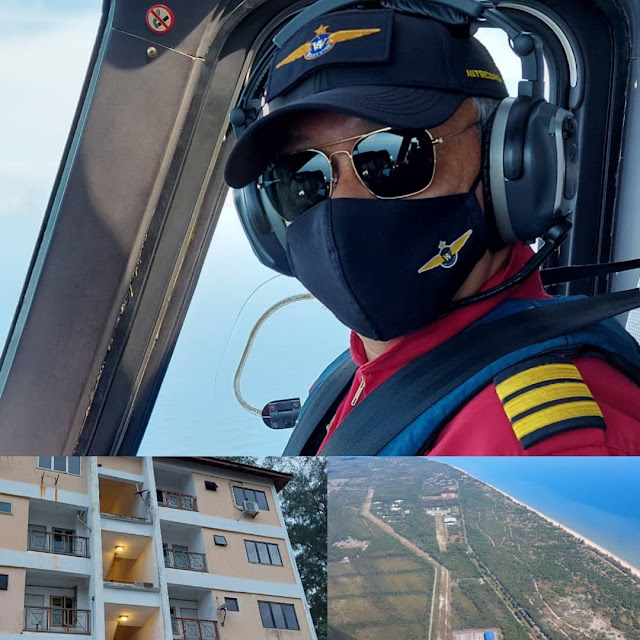
It was 9 March, with two rigs to fly to.  The first was to Malikai, not even 30 minutes from Kota Kinabalu. It was still only a fortnight since my promotion, and just my third offshore sortie with a copilot into whose hands I was going to trust my life whenever the approach to a helideck favoured the left hand seat pilot. This does require some acclimatisation. At time of writing, I am comfortable with the concept. It took me a very short time because the manning levels here in KK present me with only 4 copilots whose judgement I would have to yield to.

The winds were still north easterly. Malikai was the copilot's landing with the prevailing wind from the north east. It looked like it was going to be a predictably routine day. Since there were only two sorties, or sectors, we continued at an unhurried pace about our business with refuelling and the pre flight paperwork for the second sortie to Maersk Viking, the new kid on the block adjacent to Gumusut Kakap. 

This was to be the captain's landing, therefore the take off and outbound flight fell to me. All went well till upwind after initial take off and KK Tower handed us over the Kinabalu Radar. After the initial check in with Radar, the controller seemed unusually quiet, while paying attention to the other traffic under her purview. I prompted the copilot ( I'm making an effort to use third-person references in the interest of privacy) to request direct track to the destination from her. The controller then came back saying "WS, you are not radar identified. Turn left heading 2-9er-0 for Maersk Viking."

OK, I noted. Our transponder doesn't seem to be readable by Air Traffic Control. I checked the Control Display Unit and saw that the the Transmit cursor was blinking happily, indicating that the transponder was indeed, transmitting. Depressing the Ident button on the line select keys, I called in to the Radar Controller and declared I was squawking ident. This would ordinarily provide an identification detail on the radar scope in KK Approach. However the Radar controller came back saying "WS, negative, you are not radar identified."

I wasn't exactly frazzled, since I understood that positive seperation and air traffic services could still be provided procedurally if KK Radar could not "see" us. It would just require a little more work tracking us by making annotations on a "flight strip", that little piece of paper with a summary of our flight plan where the air traffic controller could monitor our progress. If I am mistaken, the sages of aviation can correct me.

At about 30 miles outbound, albeit a touch early, KK Radar called in and transferred us to Labuan Radar. The check in with Labuan Radar also revealed us as not radar identified. However, the controller continued to direct us to Maersk VIking and instructed us to call ready for visual descent.

As we went on our merry way, I made a cursory check on the Minimum Equipment List. There was nothing definitive in it about a Return To Base should the transponder fail. In fact for all internal indications in the cockpit, we were flying with a serviceable transponder! 

On our return leg to Kota Kinabalu from Maersk Viking, I considered our radar visibility to other aircraft in our shared airspace. We listened to various radio transmissions from fighter aircraft and helicopters from the army, navy and air force in chatter with Labuan Radar. They were prepping for military exercises over Labuan waters for the next day. I decided that after the return to KK under procedural control, I would snag the aircraft. It would not be right to leave the transponder unattended to by the engineers with sorties coming up the next day in such proximity to the airspace being used for the exercise. Hazardous. Flight safety first!

I expect that I gave the engineers and the Base Flight Safety Officer a bit of a long day that afternoon for having snagged the aircraft and raising a flight-technical incident report. The aircraft was rendered serviceable for the next day and as far as my checks with KK Helibase went, the crew of the following day flew unhindered by the transponder. I was a touch smug. Affirmation!! Vindication even!

Then came 11 March. I was due for a single sortie that morning. Fridays and weekends are rather low key. The destination rig was Malikai. Nice for a Friday, just an hour and some minutes and then home. However, once again, upwind from Runway 02 Kota Kinabalu, checking in with Kinabalu Radar brought a repeat of "WS, you are not radar identified." Squawking ident was to no joy. However, Malikai was just another twenty minutes out and in relatively safe airspace. The revenue flight continued under procedural control to its conclusion and post landing I had a word with the engineers. I snagged the aircraft again and raised another incident report.

The engineers were baffled at the recurrence. Another late evening. The following morning, ground functional checks using their test kits showed that the transponder was indeed active. But seeing that they also had a scheduled leak check to carry out with the rotors running, they had me summoned for an engine ground run. Running through the checklist items, I attempted a check with Kinabalu Tower for the transponder. And of course I was not radar identified. After shutdown, I brought this up with the engineers, with a rather grave tone of voice. I did not snag the aircraft, hoping that they could resolve this out of the books.

One of them postulated that perhaps the transponder works only in flight. I did not raise an argument because theoretically we should be detectable to other aircraft even on ground. I had seen the amber "traffic" annunciator flash on screen often enough. If I am mistaken, the sages of flight can reeducate me.

The chief enginner called for a flight test. Great. That would put the matter to rest, wouldn't it? Arrangements were made, flight plans were filed and soon we were up in the air with two engineers in the cabin to watch and hear the proceedings. As soon as we were airborne, I called in to Kinabalu Radar:"Confirm we are radar identifed?"

"WS, you are radar identified upon passing 200 feet."

We spent 25 minutes on the downwind leg to accommodate other arrivals and soon were back on the ground, happy and confident that an engineering breakthrough would see the flight of the coming week executed without a hitch. Indeed, I was scheduled for the next day for two long flights into Labuan waters where radar control was imperative.

As it would happen, the very next morning after getting airborne for Gumusut, the radio chatter from Kinabalu Radar was "WS, you are NOT radar identified......"

Yes, it seemed to be me, not the aircraft.

And yes, I got chewed up on the return to base by both Radar and Tower. Kinabalu Ground was the only friendly voice that day.

Some days, you can just never win.

27 February 2022

No Schradenfreude

My rant about being abandoned in the field couldn't have possibly been taken as a hint, could it?

It was just that: my rant. It was not directed at anyone. If I had known that a rant could effect a change of luck I would have ranted seven months ago.

But,for now, an expression of thanks is in order.

I love the vista

My thanks to all the local Captains, who, seemingly, after a lengthy period of wondering when I would be promoted and consequently shoulder some of the workload, launched a covert operation. With no regard to their personal safety, voluntarily and valiantly did they expose themselves to and as a result, were found positive for, Covid19, both asymptomatic or with mild symptoms. Or so my story goes in snarky vein.

If not for this courageous lot causing the rapid drop in availabe pilots for duty, I wonder if I ever would have been called up to assume right hand seat command duties with immediate effect. The email was at long last issued, on my employment as a Captain, and I owe them all a debt of gratitude.

Or a nasi lemak bungkus and teh halia.

12 February 2022

Night Deck Landing At Kebabangan

The month is February 2022.

I think I allowed myself a touch too much euphoria at what may have been a change of luck a year plus ago as a candidate for the command course. I was infatuated. Like many of those smitten, I stopped being careful, and had forgotten that career progression has very little to do with me, but has everything to do with what the lords desire. It isn't personal. As is the case with anyone in the aftermath of a bad crush, an odd wisdom remains. That once we recognise that our ranking generals have abandoned us in the field, it hastens the fact that we must, inevitably, soldier on.

Thus passed the year since the initial skill test. It is more than high time to recognise the writing on the wall, and move on. After all, the ink is written in my own blood, sweat and tears.

There is a life to live, and a whole year squandered is its own injustice, to mention naught of parallel injustices to which reparation will not be seen. There is, after all, a new place to readjust to: Kota Kinabalu and her peculiar charms.

When in KK, grab a bite at Limau and Linen, Signal Hill. Heartstoppingly recommended.

There are three offshore helicopter service providers here, one foreign, one state-linked and one I am serving in. The 16 offshore destinations here have been carved up between the three for equity's sake. We fly to Kebabangan, Gumusut Kakap and Malikai. A new kid will be joining us in the playground, and at time of writing sits in Likas Bay, for port health clearances after sailing into our waters, before heading to her drilling site, hopefully close to Gumusut Kakap. Which will mean profitable flying hours!

Maersk Viking as seen from Likas Bay on 11 Feb 2022

The rigs are all very nearby, most within 25 minutes flight time one way, with only Gumusut sitting an hour away in Labuan's waters. I clocked a healthy 31:50 hours in January. I was hoping to repeat this amassing, and had forgotten the retardant to that steeplechase: being night qualified for Night MEDEVAC standby. No, I am not lamenting. Merely confessing to and correcting a memory lapse.

Gumusut Kakap. Pic courtesy of the web

I was scheduled for the NDLP on 3 Feb 22. Th pre flight brief was conducted dutifuly by the Senior Training captain, who noted that my last NDLP was in September 2020. I concurred. I had not seen the night offshore vista since that date, as it was on the corner of the monsoon of 2020. The understanding in Kerteh remains, that where possible, once the Monsoon Contract launches, typically 15 November of a typical year to 15 March of the following, NDLPs are to be conducted on simulator. Which is also a point of contention as the final quarter of the year is also a scramble for slots in the simulator. And as fate would have it, I lapsed my recency come December whereupon I was sent for the command course and the rest is....well, social engineering.

To market, to market and to land on a rig! Note how PFLNG follows the viewer in the background

And therefore, it was with much nervousness (yes, after the musings of the preceding paragraph) that I walked out to the aircraft at 1822H, last light on that date according to met office.

We went through the uneventful start and taxi, and were airborne from Kota Kinabalu International Airport to Kebabangan at 1845H, in darkness save for a toenail clipping of a crescent moon heralding the Chinese New Year. As is required of the NDLP check for a pilot who has lapsed night recency, I plotted the Airborne Radar Approach waypoints into the FMS, prattled the approach chart brief to my training captain and let the matters unfold as mentally flown, with minimal hiccup.

Kebabangan in daytime. Pic courtesy of Shell's website.

Finally, there she sat ahead of me on final inbound course, plotted from the prevailing wind as reported on the Platform Status Report. Kebabangan. The night vista was enchanting, the offshore installation's lights bright and reflecting off the waves in the dark waters below her. When everything looked good to me, I called out to my training captain, "Going off the upper modes. Running in." 

The flight director was clicked into standby and the rest of the approach was hands-on. The radio operator's report that wind was at 15 knots gusting to 22, became apparent at various points in the glide path. I would find my airspeed suddenly dropping to commital speed, losing 5 to 7 knots in a second and having to readjust. The same was happening with the rate of descent, 300 feet per minute at one instance and suddenly zero at another. But if Kebabangan asked for a dance, we dance, yes?

Home again, home again, jiggedy jig!

The touchdown came sooner than my hesitations would entertain. I had another 2 circuits to complete for my 3-landing recency. The dances on the next 2 approaches persisted even with in-flight patter from the left, but everything was well within limits. Handover to the other captain was done on deck and his 3 circuits ensued. Finally the training captain had a go, and we tracked back for KKIA at 2145H. He clocked an ILS approach via ADMUS and in we went to the ops room for the debrief. Which was all rather amicable.

I am now night qualified for the next 3 months. Not half bad for a lapse of 20 months. Or rather, about bloody time!

10 January 2022

A Hobbit in East Malaysia


Farewell, Kerteh. Farewell 2021.


It is officially my 14th day in Kota Kinabalu. While parochial preoccupations in Kerteh raged back and forth, a captain in Kota Kinabalu base threw the towel in to seek his fortunes elsewhere. I was nominated to take his place. Hence, here I am.

I take it that this is my retirement posting. The way the company sees it, I only have till my 60th birthday before I occupy the top of the heap. I really think it is a blessing undisguised.

Good morning Kota Kinabalu. Hello, 2022.

There is a pace of life here which is detuned from what I am used to. The mornings in the apartment are hushed. Noise begins closer to lunch with the voices of boisterious kids and couriers from Grab and Food Panda trailing up and down the stairs. Trees stand right outside the window and the visiting birds are a reassuring sight. I have begun sleeping through the night again, although I wake at a quarter to six without an alarm, in tune with the arrival of dawn. As I used to, here in this same town, as a ten-year old.

A sparrow preens in the warming day

The first ten days were spent in laborious expectancy for the endorsement of my Sabah Work Pass. I couldn't legally do anything job related till that sticker got affixed onto my passport.

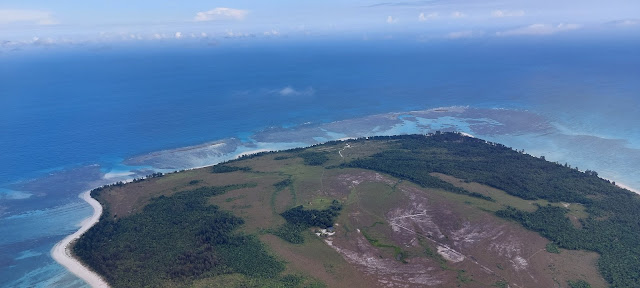
Rejoin for runway 02 via Pulau Sulug. That little smudge below the coastline.

At long last the base email announced the endorsement was passed at 1600H on 6 Jan 2022. It was swiftly followed by line training on the morrow with three continuous sectors, twice to Malikai, just 30 minutes away, with once to Gumusut under the Labuan Radar airspace taking an hour each way. I was a tad headspun on the first sector. After the luxury of a heliport all to myself, the contention for air traffic clearances and the Gatling-speed radio chatter in Kota Kinabalu International Airport was disorienting. By the second sortie, my internal filters began to function and day's end saw me handling the RT unsupervised. My training captain was not thoroughly displeased with me, although when he saw me climbing up the aircraft and jumping back down to ground during pre flight checks, he teasingly yelled out at me to the amusement of the KK ground crew,"Oi old cock!! No jumping!! Your think your'e still young is it?"

Pulau Mengalum sitting midway between KK and Malikai.

Three sectors. The first rotor engagement was at 0800H. The final shutdown was at 1505H. I clocked 5:55 in block time. I was plumb tuckered out, but an extremely happy puppy. I have 2 days of line training before my line check under the Senior Training Captain. Then, if the company deigns to award me my rank, I am free to fly with the copilots. We'll see how that fares.

12 October 2021

I Heard A Good One Today...

Rotor track and balance alongside Petronas family quarters. A beautiful day with multiple greens and several blues.

Yes, I am negligently overdue with a blog post. I have no real alibi save for the bewildering company social media policy which makes the degree of transparency I exercise in this blog, an arbitrary one. However I am certain that only a few wandering spirits linger here and with that consolation, I continue to tread water.

After the nostalgic ferry flight to my favourite city, Kota Kinabalu mid-May, I returned to Kerteh to continue my pursuit of the ever elusive 100th hour promotion prerequisite, under supervision of training captains. I did have one contractual requirement to attend to, one I abhor, called the Offshore Passport medical check. When aviators are subject to a regulatory annual medical check known as the aircrew medical under an Aviation Medical Examiner, why we are further subjected to a secondary medical requirement seems both redundant and questionable to me. None of us will ever operate a crane or torch or metal cutter on an oil rig. Yet, because the oil and gas clients can apply pressure on the helicopter service providers, offshore pilots continue to be held ransom to offshore panel doctors who sometimes prescribe medication contrary to what any Aviation Medical Examiner would ever prescribe to an aircrew. Well, since the Pandora Papers do not cover these insiduous machinations, there is little that is being done to safeguard an offshore pilot's medical wellbeing.

Whilst I digress, I needed to vent.

I dutifully submitted myself to the examination protocol. And to my blood-curdling horror, two mornings after whilst I was happily on my 5-hour road cruise back home for my ten-day off cycle R&R, I received the call from the clinic summoning me back for an audience with the doctor as my blood test results had shown me to be diabetic.

I was at 97 hours to my 100 tally. Again, I digress. But I was, and still am, shattered by that monolithic impediment to what meagre ambitions I held towards captaincy.

The hiatus in my blog posts simply indicates that many events and their ramifications are now troubled waters under the bridge.

Since the initial grim news with an Hb1AC of 10.2, I chased it down to the offshore limit of 7.9 in six weeks. My latest check after an additional ten weeks has it standing at 6.0. The journey and what I did does not require elaboration in keeping with the spirit of this blog as I see it.

Returning from offshore to meet with rain over the airfield. An instrumented approach ensured I was recurrent on my ratings.

Having cleared the OSP with the standard one-year validity, I continued my dash to the finish line and completed my 100 hours at the end of July. The paperwork took less than 48 hours to compile and submit. I wrung my hands for another one month to allow for bureaucratic hysterisis pending approval of my rank.

The news was indeed dismal. I was not to be promoted till the onset of the monsoon due to budgetary constraints. My coursemate, who sat for the First Pilot skill test with me in January, was promoted a fortnight after completing his 100 hours mid June. The melody and lyrics of What A Difference A Day Makes seems a satirical serrated blade thrust into my morale and sense of justice.

Till my promotion materialises. if ever it does, I can only fly offshore when a training captain is available to occupy the left hand seat. That, and engine ground runs with the rare but occasional flight test. My monthly hours have plummeted to an hour and a few minutes for the past two months. I will not be surprised if I attend my next proficiency check with neither additional first pilot hours nor shouldering the rank. Nor would I be surprised at what would lie ahead were there no such thing as the North East monsoon.

And that's when I heard a good one on one September morning on a supervised offshore flight. Another training captain was waiting for his copilot to prepare the navigation log before shooting off to his destination rig, with an ETD simultaneous to mine. My destination, though, was a shorter one, with a divergence of 60 degrees between us. Feigning concerns over in-flight route crossings and conflictions, he began to broadcast unsolicited advice as follows:

"Jeffrey, since our planned take-off time is the same, for traffic separation, you can take-off first. But to make sure we arrive staggered, you must not exceed 80 knots throughout."

I was not in the mood to entertain banter with anyone in my state, so I just nodded without further enquiry. Disappointed that I had not picked up the cues from his priming, he continued:

"If anyone asks you why you deviated from cruise speed and flew 80 knots all the way, you tell them it's because you are waiting for your rank and would be happy if they put the rank on you when you arrive back from offhsore."

It put a smile on my face for all of five minutes. 


16 May 2021

There And Back Again 2


Sunrise, sunrise

I couldn't have asked for finer weather on the morning of 9 May 21. We had Sahoor ready for us to take away from the kitchen at 0515H, so that we could have our tummies settled before the long dark through Moria, that stretch of open sea that awaited us. Grab drivers were available by 0645H and two shuttles took care of our needs for social distancing in public transport on this sun-up ride to the airport. Justice, or in this case, Covid19 SOP needs to be seen to be done, right? 


I accompanied LAE Shahir as he attended to the pre flight prep whilst my two copilots loaded their cardio vascular systems with enough nicotine to last the three-hour ride sans smoko breaks on the first jaunt of the day. I gave Senai Tower a call on the phone, requesting start-up clearance on their landline to conserve the aircraft internal battery power for the engine start. Delightfully, start and air traffic clearance for the departure were confirmed over the phone. Business was off to a very promising beginning. Neil, the courageous one to brave the crossing with me, was still puffing on his e cigarette before sensing the rest of us were rearing to go. Internal battery start was a little hot on the turbine temperature, but steadied as rapidly as it rose. Taxy clearance for the Kong Kong 2 departure was obtained, and we rolled to the runway centreline for the kind of take off into a view no money could buy.

The view, the view, the view!

As we tracked on the instrumented departure to Kong Kong and set course to HOSBA, the vista of Johor Baru and the city-state of Singapore unfurled before our eyes. The Traffic Collision Avoidance System showed us what a busy airspace Singapore air traffic controllers were deconflicting. The air traffic control officers were friendly and courteous. On the easterly heading for Kuching, we were offered a cruise level of 5000 or 7000 feet. We gladly accepted 5000 feet so that the engines' power index could be kept within calmer limits at altitude. Transponder codes were puched in and soon we were enjoying the cruise. Singapore's silhouette passed us on the right. I managed to identify Seletar, where I was trained in airfield fire fighting and rescue way back in 1991. Nostalgia and wonderful weather conditions. Days like these make the job seem amply worthwhile. 

A jumbo cuts across our nose

Soon, we lost sight of all land. Now and then a distant island would pass us on the right, rugged, untouched and rather Bali Hai. The weather remained persistently pristine. Far into the horizon were little cumulous fronts floating serenely above the mirrored sea. We would pass through one front, and another would wait ahead, like some game of airborne hurdles. We looked around at each other with just one question on our minds, since everything else was so fine, only one item remained with an unticked box. Neil articulated it: "I hope everone's bladders are still holding out." No sound from the engineer. He didn't have a headset. "I'm good!" came back Sharvind through the intercom from the cabin. To ripple everyone's optimism, I just said, "Well.......we'll see."

Just after TOMAN, Singapore Radar buzzed in "9MWAH, do you have HF?" Ah, the moment of reckoning! I pointed to the SATCOM, and on cue as we had discussed, Neil answered "Negative, Singapore Radar. We have SATPHONE as included in the flight plan."

I'm at a payphone

"In that case, 9MWAH contact Singapore ATC on 65 and thereafter 65431629."

SATCOMs are always a bit of the roll of the dice. However, after a few attempts and bad lines, Neil did manage to get through, and I assured Singapore Radar that all was well. Subsequent position reports were managed through the SATPHONE, all the way to ATETI whence we were instructed to contact Kuching Radar.

Ok, it has been 2 hours 30 already. I need a view change. And a fire hydrant/tyre

Just at that very cloudy handover point, whilst checking in with Kuching Radar, I cheered through the intercom: "Tiara! Tiara!" Sharvind came forward, peering between the front seats through the polyethelyne barrier and called out "Laaaaaannnnd ahoy!"


Then you break cloud and the glorious sight of land greets you

It was only upon sighting land that I knew, my bladder would hold out till touchdown at Kuching! I began feeling rather positive about the remainder of the journey. 25 minutes over land and a few dog-legs later, Kuching airfield came into view. I declared airfield in sight and brought her in for touchdown, taxy and requested refuelling at the General Aviation apron. No sooner the rotors had stopped turning, everyone made a beeline for the gents, and saw to the paperwork after. There was a minor hiccup with the flight plan from Kuching to Miri, but it was quickly resolved with a call to the vigilant Duty Captain at home base. On terra firma, the emptiness of missing second breakfast and the call of elevenses became audible. Nothing that a quick sprint to the McD in the terminal wasn't able to fix!

Within good time we wrapped up post flight and pre flight, the same landline clearance for start-up was obtained and again, off we set for Miri. It was another hot start, but well below transient limits. I was told that Kuching's ATC was cantankerous, but they were in fact, as amiable as I've found them to be during "my RMAF days, what what!" 

Our flight planned route was one I had specifically chosen from Miri via Tanjung Manis and Mukah. Only four heading changes. ATC was accommodating but we had to call abeam Bintulu and Sibu as other lesser aircraft opererators were plying the parallel routes and they needed our position reports for safe air traffic separation. After passing Mukah, we spent much of our time over larger expanses of water. With the coastline far to the right, we were clear of other traffic and the radio chatter fell to a minimum. There was some weather build up over the coast, but cruising along at 1500 feet, "feet wet" kept us in clear skies and horizon, affording us a pleasant VMC view till the sunny touchdown at Miri.

Loading up the waypoints on the FMS

Again, LAE Shahir worked promptly with the engineering boys at Weststar Miri Base on the refueling and turnaround checks. Sharvind, who was to fly the final leg, ie Miri to KK, took advantage of base support's ground power unit to load up the subsequent waypoints for the trip. Meanwhile, Flight Ops Miri had already obtained approved flight plans for our final leg

Miri was not altogether busy that afternoon, so start up and taxy to line up for take off was as uneventful as it was unimpeded. The route to KK was again, one I picked, right from memory of Ops Jaga Kawan when I'd fly the Nuri down to Miri from Labuan and back for the army's troop changeovers and resupplying their needs into Bario and Ba' Kelalan. Sharvind was the left hand seat pilot for this leg whilst Neil was in the cabin enjoying the view. We crossed Batang Baram, passed abeam Anduki and looked down over Tasik Merimbun. Just before leaving Brunei airspace, Neil pointed out his dad's village passing below us at Batu Danau. Looks like everyone gained some good on this trip. Exactly as we had anticipated when we got the news.

If our engineer is happy, evryone is happy

Passing overhead Neil's hometown, Limbang, Labuan began to drag into view. I was a copilot here from 1997 till 2001. I made Nuri captain here and was posted to KL Base as a line pilot from 2001 to 2005 during which I had my missing-after-ejection fighter pilot rescue and my stint in tsunami-ravaged Acheh. Then after paying my dues in MINDEF for three years, I was glad to be posted back here again as Squadron Exo from 2008 till I quit the air force in 2010. No, Adam Levine, you don't get to sing that adulteration of Canon in D minor at the expense of my memories! Not on my watch!

Abeam Kinarut, KK airfield in sight!

It was with some ruefulness that I noted the retrogade path Labuan's oil and gas scene had taken of late. The waters just off the coast of Victoria to Pulau Daat had turned into a vessel and jack up rig graveyard. Hmmmm. Gazing at Labuan with more pleasant recollections, I buzzed Labuan Radar to convey my best regards to No 5 Squadron and set my sights back to the waypoint of Kuala Penyu which pointed towards KK.

Four jack up rigs huddled together in the watery graveyard, reminiscing on better days past

It was nearing 1700H when we finally lined up on finals runway 02 Kota Kinabalu. The long journey was just beginning to gnaw at me, but the sight of KK gave me second wind for the grand finale. We shut down the aircraft and handed her over to the Base Manager KK, with much relief. He on his part, had most hospitably arranged the KK CIQ stamping of our passports with Immigrations at his Flight Ops after which we were swifly whisked to The Promenade Hotel for the night courtesy of his base transport. Yes, as the Covid19 SOP would have it.

A check on the company email while milling at the hotel reception showed us that our flight tickets for our ride back to KLIA and then onward to Kuala Terengganu were uploaded for printing and scheduled for the following morning. I'd like to make a special mention over a Ms Hyzol (pronounced Hazel) of the front office at The Promenade, who did us the great favour of printing said tickets that night itself on our request. God bless!

The job was done. And I had an excellent team making this a success.

15 May 2021

There And Back Again 1

The ferry flight crew before starting-up for departure from Kerteh. LAE Shahir, SFO Sharvind, moi and FO Neil

It was with both excitement and trepidation that I received the news early in the first week of the month that I was to ferry an aircraft from Kerteh all the way to Kota Kinabalu via Senai, Kuching and Miri. Excitement at flying for the first time with copilots, excitement at heading to Kota Kinabalu, the town I grew up in, excitement at the prospect of flying through my old East Malaysian operational playgrounds from my air force days. Trepidation? Over pretty much the same things, so new into the right hand seat. But I had a history to fall back on, and to see how much of that reliance held true.

The ferry flight was initially scheduled for 15 May 21, but with misgivings over the impending Aidil Fitri celebrations mired with a rising Covid19 pandemic infectivity crossing the 3000 persons a day rate, it was decided that flying off a week earlier would be prudent.

Leaving Kerteh

The planned route was from Kerteh to Senai first, on 8 May 21 for a night stop. Then, for a bright and early departure on 9 May 21 from Senai on a direct track through Kong Kong, HOSBA, TOMAN, OBGET, NIMIX, ATETI and MOXUN, thereafter to land at Kuching for refuelling. The next stop would be at Miri, refuel again and finally deliver the aircraft to Kota Kinabalu Base.

Passing by the east coast reporting points of Pekan and Mersing

There was of course the initial mad scramble to get the swab tests done, the prerequisite to obtaining entry into Sarawak and Sabah, getting authorised travel requests,  cross-border police permits and accomodations, all thanks to Covid SOPs. We got them all sorted from 24 hours before till about 20 minutes to scheduled departure. 

We gathered at Flight Ops at 1400H for a preflight brief. While we loitered in the Flight Ops room waiting for the various legalities to filter in, our very concerned Chief Pilot hung around with us so that he could bid us a proper farewell and safe flight. At last, we had our General Declarations, state entry-exit permits, police permits and a To Whom It May Concern letter to facilitate the exisiting documents. My dutiful copilots took custody of the documents for later evidence of legal transit and we ran a final ticking off of our self made checklist before feeling satisfied enough to step down to the flight line office. We were ready to roar at 1435H.

I caught up with our sole Licensed Aircraft Engineer who would be riding on board, and the crew headed out onto the tarmac together. Snapshot by the starting crew, we then clambered in to get the show on the road. Sharvind was to be the first to fly with me. We lined up on the runway for the daily power assurance check, and then started our 2 day sky trip with a take-off and climb to 5000 feet as per flight plan. Weather was very bright and hot, and we were unanimously grateful for a serviceable aircond. After passing abeam Kuantan we descended to 2000 feet for the scenic view, and thus we flew past Pekan, Nenasi, Mersing and all the way dodging minor clouds and terrain gleefully till touchdown at Senai Airport. After shutdown and securing the aircraft for the night, we headed to Perth Hotel, just beyond the airport fences, for preparatory sleep for the long haul awaiting us at sunrise.

Corrine Bailey Rae, there are other reasons for having trouble sleeping. The morrow was going to be the moment for truth for me; my first crossing from the peninsula to East Malaysia, my first time since the command course that I would be flying with copilots as opposed to with training captains as I was still under line supervision, my first dealing with Singapore's stringent air traffic control in an aircraft not carrying HF radio for the crossing, and on a route directly over the sea for three straight hours. Going over all these in my head, sleep only came at 0300H.

This was going to be, not a test of faith, but bladder control.

More in the next post.

28 January 2021

Hey Diddle Diddle

Finals approach, West Desaru MOPU on 15 Jan 2021. First flight of 2021. First flight Right Hand Seat.


I have been away from this blog for 6 months. That's not a good show in a realm where each flight day is always eventful, and yet, I have been swamped by a lethargy which self discipline could not override.  I simply could not muster the spirit to write with any anecdotal conclusivity.

It's not only that Covid19 has inundated the entire planet, but that closer to home, and many aviators will agree, things do not look altogether prospective even with the buzz of a vaccine on the horizon.  This isn't about a lack of gratitude at still holding down a job, as we can all readily acknowledge that unemployment is a parallel epidemic on its own, holding hands with Corona like the dish that ran away with the spoon. It is rather an indication of the climate hovering over Kerteh for the indefinite present. Rumours of downsizing and who's next haunt the hangar while all hands on deck, from boss to janitor, move on from day to day, some prayerfully and some others yet, slanderously.

HAZMAT ready fo a PUI flight
Over the past number of months, a few incidents have occured to break the monotony of skipping from payday to payday. Amongst the more interesting of those was my last carriage of two PUIs from MTC Ledang, an offshore vessel on 9 December. I had gone outbound garbed in a HAZMAT suit et alia, and later at night was celebrating the little adventure over dinner and drinks with my colleague Niel, when the ominous call came from my Chief Pilot telling me that those two boys tested positive for Covid19. That didn't stop either  Niel or I from downing the last drop of soju, but both of us were called by Ministry Of Health representatives later in the unholiest hours of the night to notify us to be prepared to be quarantined. By late morning, Niel was whisked away to a quarantine centre in Marang. The MOH deemed that since I was in full HAZMAT suit, gloves, and remained in the cockpit protected by the cockpit barrier, I did not fall into the definition of "close contact" and could be left unattended to till someone higher up the payscale decided that I needed government branded TLC. I am glad to announce, that nobody loved me.

The rest of the year took a rapid swing like a tail rotor drive failure, to change my Christmas hols. I was unexpectedly assigned together with a colleague, to ground classes and simulator training spanning from 21 Dec 2020 to 3 January 2021. Yes, any course which runs from one year to the next cannot be trivialised. While I rued the lost time with the family initially, and for only nanoseconds, I realised that I had other ghosts to exorcise. Returning to the same classroom where I had been two years back, unreeled the trauma and ensuing phobia of  my initial course.
Hey Captain Alfredo! Who's The Coolest Guy now? Please read https://hobbit1964.blogspot.com/2015/10/the-coolest-guy.html

With a rather different outcome to the course this time, I surmise that we are not be held ransom to our past forever. I have it on good authority that anyone who sets his hand to the plough and then turns to look backward isn't fit for the Kingdom Of Heaven. Just like flying from the right hand seat, sometimes all we need, is a change of perspective. 

07 June 2020

Virulence


Is it not a strange fate that we should suffer so much fear and doubt for so small a thing?---JRR Tolkien.


Small as it may be, the current virus has tossed the entire world into disarray.

In somewhat viral irony, it became the very Trojan Horse for our political quagmire and the collapse of a democratically elected government. I won't wax political. I'll just say that I find the entire affair rather slutty.

Meanwhile, back at work, as a segment of both, the nation's oil and gas industry as well as the transportation sector via aviation, business continued, but it was rather business as unusual.

It was a bit scary at first, when at the turn of the year, company small talk revolved around pilots having to fly suspected Covid19 carriers. I did wonder what this would entail. Covid19, at January's end, was almost someone else's worry. If we shut our eyes tight enough, we wouldn't get it. We had faced lots of weird viruses and epidemics and yet not everyone was affected by the Nipah virus, the Coxsackie hand-foot-mouth disease of 1977 which seemed to favour young kids, or the SARS of the new millennium. However, the virulence of Covid19 meant that within days of the February 24th collapse of the government, its wildfire had spread far and fast enough to reach the further fringes of offshore helicopter aviation around the world. No matter if we buried our heads in the desert sand, this one would not pass us overhead.

As things would have it, my first Covid19 Person Under Suspicion (PUI) extraction was on March Friday the 13th. The route was to Angsi Alpha, relatively nearby. The myth and fluff of the pandemic had me trepidated for a while, but I had been in these situations countless times and I decided to throw myself into it. The sortie was rather uneventful, and upon landing from the mission, I was to return home straight away and self-quarantine till the PUI's Covid19 test results came forth. After three days of being a complete slob, the group chat text revealed the PUI had tested negatively and I resumed work without hesitation. As the days passed, PUI extractions continued steadily, alternating between increasing frequency and being sporadic, like heaving breaths of the pandemic itself. The company slowly evolved the Covid19 Protocol. Eventually, the wearing of decontamination suits became optional, which set my mind at ease. 

I realise that I was fortunate to be assigned such duties as to carry PUIs safely back to shore where they can be provided the appropriate medical intervention as may have been neccessary. Nothing about that privilege needs elaboration.

We are all well aware that Covid19 is embedded in our communities for the long run. From Leonardo, the current OEM of the AW139 to the company's engineering arm, accruing to the initiating documents from the OEM, plans are under way to install a cockpit-cabin barrier to enhance the current Covid19 aviation social distancing in flight. Our maximum passenger load now stands at six, which is half the seating capacity. This has made life easier, since the seats occupiable are already designated. I no longer have to haggle with the Helideck Crew to restrict any passenger load less than eight pax strong to the first two rows only, keeping the centre of gravity somewhat centred in order to preclude any instance of a tail-down moment upon lift off. Some days, we win some.

Flight scheduling seems to have plunged off a graphical precipice. Upon the end of the monsoon contract during which the sortie board often reached 22 flights per day, we now see the busiest days having only 4 flights. An influx of new pilots without offshore experience into home base Kerteh has further curtailed how often I get to go up in the air. Priorities mean that they get assigned flights more often on the offshore sectors of lenient clients who don't prerequire 50 hours of offshore experience, after which they become eligible to fly for any of the snooty clients we serve. Pilots with ample offshore hours, therefore, literally have to take a backseat for now. I thought clocking 33 hours in April was bad. I clocked 7.15 hours in May.  Some days, we lose a few. I say this even with the neccessary gratitude of being employed.

Yes, I know I am not the only one in the boat. So we keep on rowing through these treacled times. I say a small prayer for my bretheren in the fixed-wing aviation world who bear with the deeper scourges of the virulence of these days. May they glide to a soft landing soon.


15 March 2020

Zero Dark 45


Angsi Alpha at 0045H
Night Standby. That is a rostered MEDEVAC standby duty that many a pilot here would volunteer to be placed on. Over the years from 2014 when I joined the company till this very night, there were about ten MEDEVACs (medical evacuations). Probabilities being on the low, with the Scrooge fisted reluctance on the part of clients which preferred their infected offshore boys hitch a ride on an existing flight under the IDOM (infectious disease, offshore management) rather than declare a dedicated MEDEVAC at a premium, normally meant that a pilot on night standby from 2200H till 0800H the next morning,  has a pseudo off day, not having to come in to work and instead binge watch Netflix with one ear open for an ominous phone call in the wee hours of the morning.

I have never volunteered for night standby. And on the night of 27 February 2020, on the stroke of 2200H, I set my ringtone to loud and began tossing about in bed in anticipation of the customary early morning flight of 0715H following an uneventful night standby. My mind had just wandered off enough to court slumber when the phone rang. Seeing the Flight Operations Officer's caller identification, I went into scramble mode. Apparently some chap on Angsi Alpha had developed an alarmingly rapid pulse rate and warranted a night MEDEVAC to Kuala Terengganu hospital.

The call had come in at 2225H. I jumped into my prepared flying suit and grabbed my headset and flight bag. I jiffied down 5 floors of the apartment and was soon at breakneck speed to the Planners' room at the terminal building, arriving at 2305H. Not bad, considering that the ketum-swigging motorists I encountered on the road refused to be outdone by an Elantra-driving MEDEVAC pilot trying to get airborne ASAP in order to save a life.

My aircraft captain turned up at 2315H (I smirk). The aircraft was fuelled up and the starting crew ready at the terminal at 2330H, and about ten minutes after that, the tower air traffic controller turned up and had fired up the radio comms. We were in business!!

Seeing that the prevailing winds favoured the copilot's approach to Angsi Alpha, after start-up, the controls were handed over to me for the outbound leg. I took the aircraft out to the runway, brought the good girl into a hover and carried out the take-off. Passing 1500 feet, a left hand turn and we were on course to the rig.

I love night flights. The weather enroute was a notch cloudy, and the night time vista is always somewhat calmer, less frenetic than daytime flights. You're not jousting with other helicopters to and from the rigs for airspace, altitudes, traffic separation or getting a word in edgewise on the radio for range calls amidst the flurry of company gossip crowding the company chatter channel.

This being my approach to the rig, I advised the captain that I would opt for an airborne radar approach (ARA). This is where a procedural step down and distance markers to the finals approach would be used with the weather radar returns providing the positive marking of said distances, up to  an abort point if deck visibility were to fall below 1 mile to the helideck. However, seven miles before Angsi, I could see the rig glimmering like a jewel in the distance, and continued visually to complete the night deck landing without incident. It was 0045H at touchdown.

The aircraft captain left me at the controls, rotors running, to use the mens' room below the deck. I stayed in communication with the helideck radio operator and enquired into the status of the patient. The RO asked me how many minutes I could spare till fuel became critically low. I looked at the gauges and said "Ten minutes." Well, we had much more than that, but I hadn't the liberty to use the men's room with my captain below deck who seemingly had no intention of resurfacing even after 30 minutes had passed. I had to reserve bladder capcity, so the earlier we lifted off the earlier I could seek relief. The RO checked in with me on the fuel state at regular intervals and ten minutes was my just as regular answer.

Half an hour had passed. I asked the RO if the captain was anywhere nearby because I wanted to relay the fuel state to him, but the RO did not have him in sight. I guess he was having a coffee. Forty minutes passed. The RO checked in with me again,  and I told him that the critical fuel level would be reached in five to seven minutes idling time. I understood the constraints: heart case patients had to stabilised before being put through the rigours of a flight. The RO bemoaned the fact that this was taking longer because just before being lifted up in the stretcher, the patient began gesticulating that he didn't want to leave and have his friends shoulder his workload. I don't know if it was the medication or comradeship, but it was getting ridiculous.

But, thankfully, on the dot of 7 minutes later, i saw stirrings at the staircase folding gates, and led by the captain, the medical attendant and the stretchered patient made their ambling way to the aircraft. After ensuring that the patient was secure in the aircraft stretcher with the medical attendant reassuringly beside him, the captain then came into the cockpit, assumed control and we lifted off into the night on our merry way to Kuala Terengganu. While he flew this leg, I handled all the communications with the air traffic controller at Kuala Terengganu and coordinated the rendesvous point for the ambulance.  The captain carried out the approach and landing and we taxied our way through unlit taxiways to the flying club apron where stood the awaiting ambulance. After application of brakes and idling the engines, I got off to coordinate the ambulance to a safe distance outside the rotor disc. And this is where the word "expeditious" vapourises into the night air. The ambulance staff cleverly stopped outside the periphery of the running rotors as per my hand signals. But they expected me to direct them as to how to handle the patient. Equally clueless, the medical attendant kept looking at me for instructions on how to off-load the patient. Lads, this is where you step in and perform your functions. Were this a military operation, yes, the aircrew steer the entire mission. But on civvy street, a pilot is just that: an operator of an aircraft. He is not to interfere with or assume control over another specialist's function.

In the end, the medical attendant, after running short of ideas, yanked the oxygen mask off the patient, unbuckled his restraints and made him clamber over the on-board stretcher and hop onto the ambulance's gurney. The ambulance staff were still standing agape as if this MEDEVAC were a spectator sport. Once they were all clear from  the aircraft, I strapped in, called for taxi and take-off clearance, and I set back to Kerteh at 4000 feet for an instrument approach from overhead Kerteh's VOR station to a safe landing at our home airfield.

It was 0300H at touchdown on the tarmac at Kerteh. After submission of the paperwork at flight ops office, I did the unthinkable and drove to the landmark pride and joy of Kerteh, depending on whether or not some comedic boycott is in session: McDonald's. A cup of salted caramel and my first sampling of nasi lemak McDonalds concluded the proceedings of the morning, and I spent the rest of the morning being an unregistered zombie.

And I still never will volunteer for night standby.